- Undisclosed Medicaid Fraud Investigation by State Agency Alleges Fraudulent Billing & False Claims Act Violations
- False Claims Act Fines Could Be >$1.2 Billion
- FOIA’s for Medicaid Data Revealed Carrier Test Anomalies That Suggest a “Pattern of Billing Fraud”
- Attachment Rate for Billed Carrier Tests Is 170% Higher Than Competitors;
- 120% Above the Theoretical Max Attachment Rate
- Est ~80% of EBITDA at Risk of Going Away
- Former Reps Admit to Deductible Capping; Exec’s Say this Violates Stark & is “Against The Law”
- 4/5 Oncologists Don’t Recommend or Have Decreased Usage – “It’s a Commoditized Test”; “It’s Worthless”
- Doctors Reveal Studies Have “Cherry Picked Data”
- False Negative Problem in BLLN’s NIPT Test – An OBGYN’s Worst Nightmare
We are short BillionToOne (BLLN) a medical diagnostics company that IPO’d in November 2025 and trades at a nose-bleed ~12x P/Sales ~$5.3 billion market cap on Wall Street’s hopes for its fatherless prenatal testing franchise and oncology “optionality.”
Our FOIAs, state Medicaid data, and interviews with dozens of former employees, doctors, genetic counselors, and industry experts revealed a very different company, one that is already under an undisclosed state Medicaid fraud investigation, running an illicit patient-assistance program that formers say is “against the law,” carrier test attachment rates hitting attachment rates that are 2.2x higher than should be mathematically possible, obfuscating a false negative problem that doctor paid by BillionToOne then felt compelled to expose in medical journals, selling an oncology test its own former C-suite calls “a commodity,” and cherry picking patients to make head-to-head oncology studies look more positive. When you find 1 cockroach, there are always more hiding, and we so far we have found a lot hiding in BillionToOne.
Suspected Fraud by State Medicaid Investigators — Undisclosed & Revealed via FOIAs
- Tennessee’s Office of Program Integrity made a “Suspected Fraud“ referral to the bureau of investigation into BLLN’s billing in 2024 after 11 tips
- This remains UNDISCLOSED to investors.
- TN investigators found “a credible allegation of fraud has been established” and allege violations of both State & Federal False Claims Acts.
- BLLN switched billing to “unlisted” CPT codes paying ~$2,380/claim vs. $62–$343 for appropriate codes — a ~10x rate.
- Audit found a 100% error rate in claims sent to Medicaid — 53/53 claims reviewed were found to be unsupported.
- The BLLN case was referred to the Medicaid Fraud Division & appears still active in FY 2026.
Michigan Medicaid Data (a Separate FOIA) Indicates Systemic Overbilling for Carrier Tests
- Carrier screening is a once-in-a-lifetime test; no one should ever do it twice because your genetics don’t change.
- Only ~40% of pregnancies are 1st pregnancies so theoretical max carrier attachment rate is ~40%.
- Michigan Medicaid data shows BLLN submitting claims with an est ~88% carrier test attachment rate.
- ~120% above the theoretical ceiling
- ~170% above competitors Natera (32%) & Myriad (31%)
- Former sales reps confirmed they were pushed to boost carrier “attachment rate,” corroborating the FOIA data.
- Reps said others had carrier attachments in mid 70s-80s & 80%+
- False Claims Act penalties could exceed $1.2 billion
- >80% of EBITDA could be at risk from excess carrier attachment billing.
Capping Deductibles & Co-Pays Without Income Verification = Illegal Kickbacks
- Former BLLN execs said the program is “against the law… it’s inducement… it would be considered a Stark violation“
- BLLN Sales rep documents posted in doctors’ offices: “No W2 or additional paperwork is required to qualify”
- Secret recording catches a BLLN rep red-handed in Q2-2026 promising “We don’t verify their income with W2s”
- Reps promise patient deductible caps of $99–$349 while billing Medicaid & insurers thousands of dollars
- Progenity used this same playbook, which resulted in paying a $49M fraud & kickback settlement.
- Fittingly: 33 reps that worked at BLLN came from Progenity (~14% of the sales team)
- VP of Reimbursement came from Sequenom — also accused of a price-capping scheme.
BLLN’s Undisclosed “Baby Peak” Secret Program – a “Sketchy” program that incentives patients to get expensive carrier tests (billed to insurance) by revealing to parents not only the baby’s gender but if they will have curly hair, a sweet tooth, like cilantro, etc.
Alleged Kickbacks to Doctors via overpayment for blood draws and phlebotomists to staff their offices
Oncology is really “a Commodity” — And It’s Priced at ~90x Sales
- Former BLLN C-level exec on Northstar Select: “it’s a commodity”
- 4 out of 5 oncologists we spoke to either don’t recommend Northstar or have cut their usage
- They called the product “a worthless test” a BTO a “me-too company.”
- The nice ones told us Northstar was their #3 choice vs the competition.
- The more blunt ones said the only oncologists they know using Northstar are “not academically inclined”
- Multiple oncologists experienced Northstar Response results reporting the opposite of how their patients were actually doing.
- One said “If we had ignored the scans and trusted the [BTO] test, we would have done the patient a significant harm.”
- Concerns with BLLN Oncology studies – Dr’s told us the Oct 2026 head-to-head study vs. Signatera relies on “Cherry-Picked Data” & even used an old version of the competitor’s test.
- Adding back in the removed data drops Concordance from 94% to 73%
Insurance Companiess Have Started Uniforming Denying BLLN’s Proprietary Code
- Ambetter (~17% of the ACA market) stopped accepting BLLN’s proprietary Unity code in 2026, will others follow when they learn about the “patterns of inappropriate billing,” deductible capping, & excessive carrier testing?
- Elevance cut median reimbursement on BLLN’s carrier code to $9.12 before BLLN sued.DSOs have ballooned from 38 days at IPO to 65 days in Q3 — AR is growing ~3x faster than revenue
- Could this be because Insurers have stopped paying?
- Does insurer rejections, increasing DSOs, and true-up problems signal the end of growth?
False Negative Problem Related to Missing Cystic Fibrosis Cases Exposed by a Doctor Who Helped Author a Recent BLLN funded Study
- You know a company has a false negative problem when it’s own paid docs start writing letters exposing it.
- BLLN claims they had 0 false negatives. Docs and Genetic Counselors told us about a multitude False Negatives.
- We learned about lots of missed Cystic Fibrosis Cases, Down Syndrome ones, and others. Drs said the NIPT studies suffered from some of the same “cherry-picked” data problems.
- NIPT Expert told us they had heard of >120 False Negatives
Supplier and Other Problems:
- Key supplier Illumina is suing BLLN for patent infringement — a former calls it “the single largest risk to their revenue from UNITY.”
- Another supplier, Complete Genomics, got placed on the DoD’s Chinese Military Companies list in June 2026; its sale to a Swiss buyer remains stuck in CFIUS review 9+ months later
Insiders Selling:
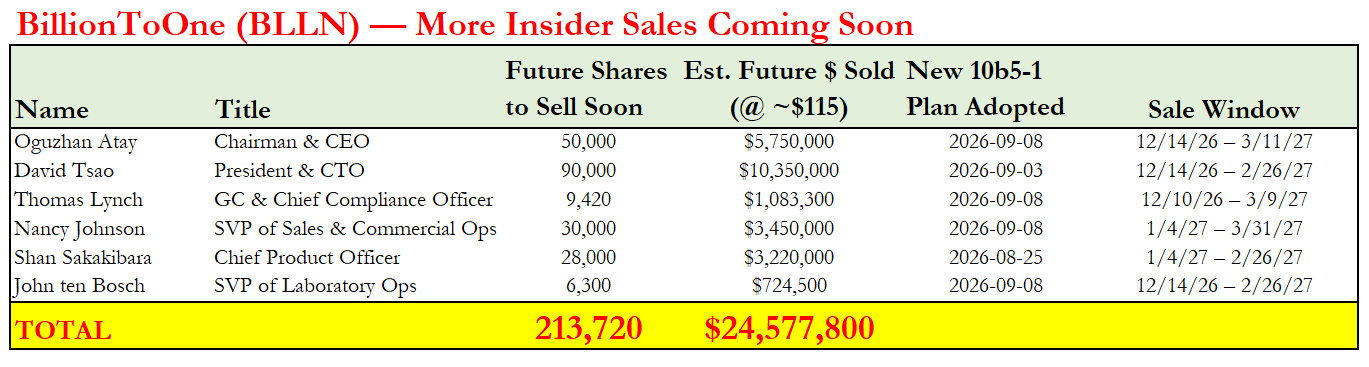
- Insiders have dumped ~$58.5 million of stock since the May 2026 lock-up release — and all six top sellers just filed plans to sell $24.5 million more.
We’ve seen this movie before. NIPT companies that commit insurance fraud can go from billion-dollar valuations to bankruptcy or acquisitions at fire-sale prices. Was Billion to 1 named ironically?
Government regulators suspect Billing Fraud and False Claims Act Violations, and so do we. We also have the documents, records, statements from former employees, and public Medicaid data to help prove it.
Fuzzy Panda Research is Short BillionToOne (BLLN)
Fuzzy Panda Research and Fuzzy Panda “Affiliates” are short securities of BillionToOne (BLLN). Please see additional disclosures at the end of report and in our terms of service.
Whistleblowers Note – Former BillionToOne sales reps or employees, competitors, medical providers, or anyone with more knowledge about BillionToOne’s suspicious “pattern of inappropriate billing” or excess carrier test billing can reach out to us by emailing us at [email protected]. We will protect your anonymity!
PART I – FOIAs Expose Undisclosed Medicaid Fraud Allegations – Short BillionToOne (BLLN)
Undisclosed Medicaid Billing Fraud Investigation Revealed
- “Violations of False Claims Act” & “Suspected Fraud” Allegations By State Regulators Related to a “Pattern Inappropriate Billing”
- Investigators Uncovered BLLN Switched to Billing for Unlisted CPT Codes (Which Paid a ~10x Rate)
- Suspected Medicaid Fraud Allegations Referred to Bureau of Investigations & Appears to be Ongoing
BillionToOne has failed to disclose to investors that they have been under a suspected fraud referral by at least 1 state regulator for allegations of Medicaid Billing Fraud.
Through public records requests we uncovered an undisclosed investigation into potential Fraudulent Medicaid Billing that was opened by state regulators. The suspected fraud investigation began all the way back in 2024 after the state agency received 11 tips of regarding potential fraud and as of our FOIA date in early 2026 it clearly appears to still be on-going. BLLN IPO’ed in Nov 2025 but has still NOT disclosed any Medicaid fraud investigation.
Our FOIA’s uncovered that the Tennessee’s State’s Office of Program Integrity looked into BillionToOne’s billing practices. The TennCare’s investigators determined that “a credible allegation of fraud has been established” against BillionToOne. The OPI then referred the BTO case of suspected billing fraud to the Tennessee Bureau of Investigation’s (TBI’s) Medicaid Fraud Division.
The Tennessee regulator concluded that they “Suspected Fraud” and alleged:
- A Pattern of Inappropriate Billing
- BTO Engaged in CPT Code Switching (a classic area of abuse)
- BTO billed for non-covered laboratory services
- Violations of both State & Federal False Claims Acts.
Unfortunately, everything related to the Medicaid Fraud Division after the OPI referral has been redacted in the documents we received, but we can see from the file list that documents were being added to the investigators in 2026 as of the date of our FOIA, so it appears that it is on-going.
BillionToOne could easily clear up any confusion via proper disclosure. Management needs to immediately disclose if any state or federal Medicaid regulators are currently investigating the company for fraud.
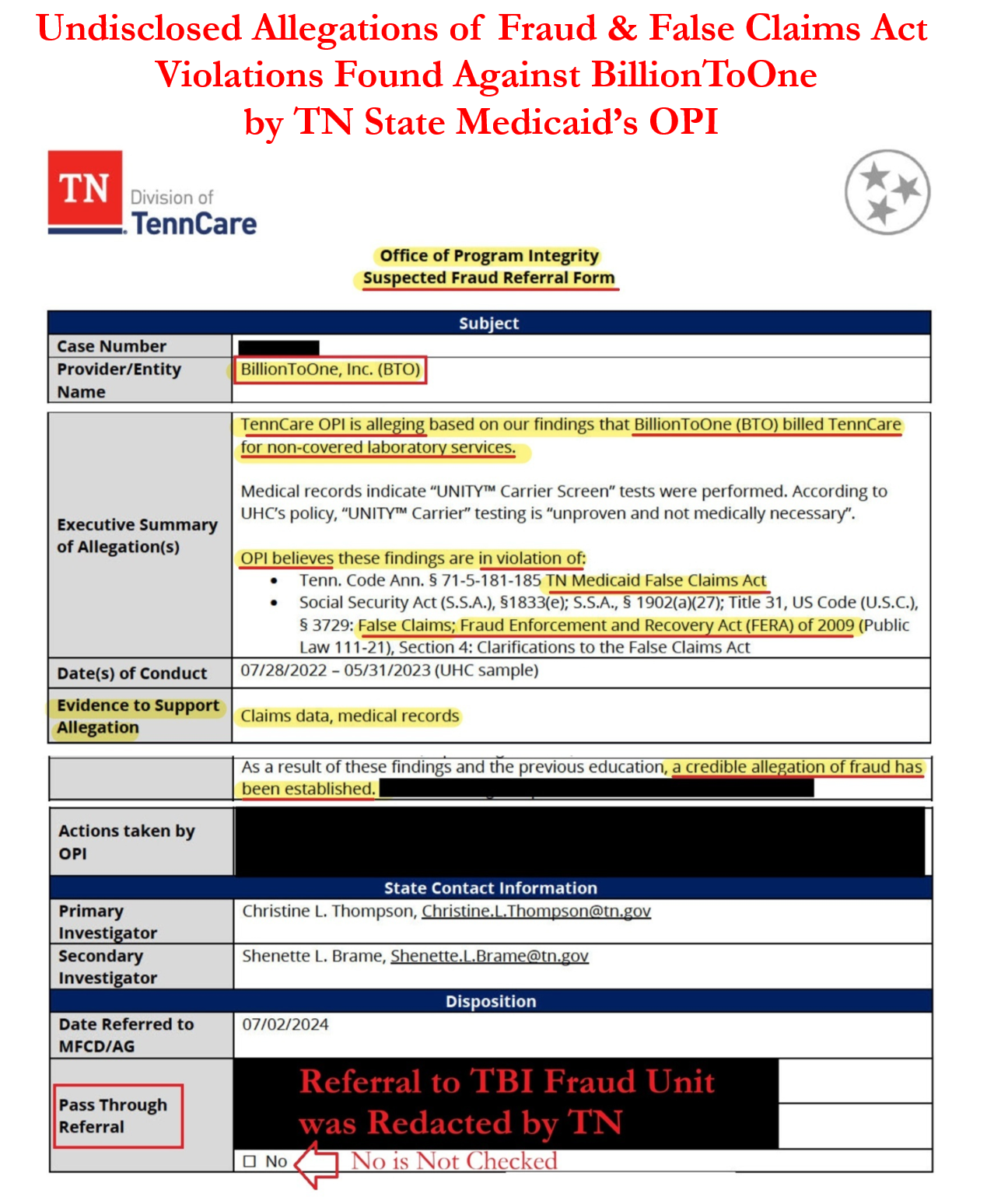
Source – FPR FOIAs; Tennessee – OPI Suspected Fraud Referral Form (pg1, pg 2 & pg 5)
We received >75 documents from Tennessee regarding their inquiry/investigation into billing fraud occurring by BillionToOne. The major findings/allegations we saw by the Tennessee investigators were:
“Pattern of Inappropriate Billing”
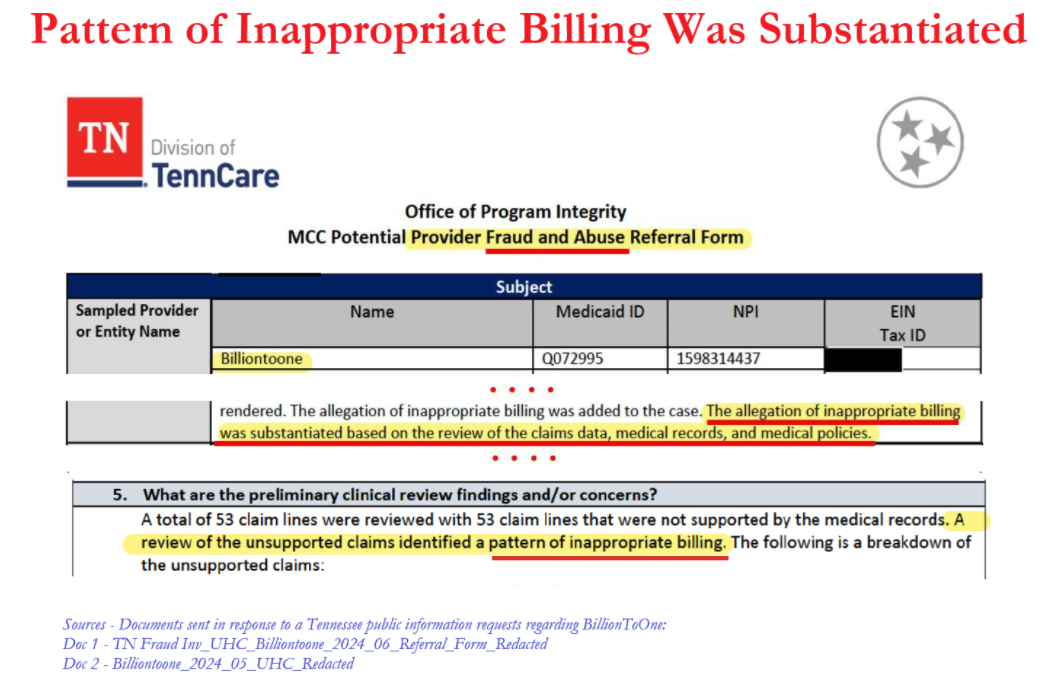
Sources: Tennessee – OPI Medicaid – Potential Medicaid Fraud and Abuse Referral Form (Pg. 1,3) & Audit Exposure Form (Pg. 2)
BLLN Engaged in CPT Code Switching to “Unlisted CPT Codes” which had an est ~10x higher reimbursement
The suspected fraud referral highlights that BLLN switched to billing for “unlisted” codes when more appropriate codes were available. The referral states that “Unlisted codes are often an area of abuse” and that the codes BLLN switched to billing for paid an average of $2,380 per claim vs the other codes paying an avg of between $62 to $343 per claim.
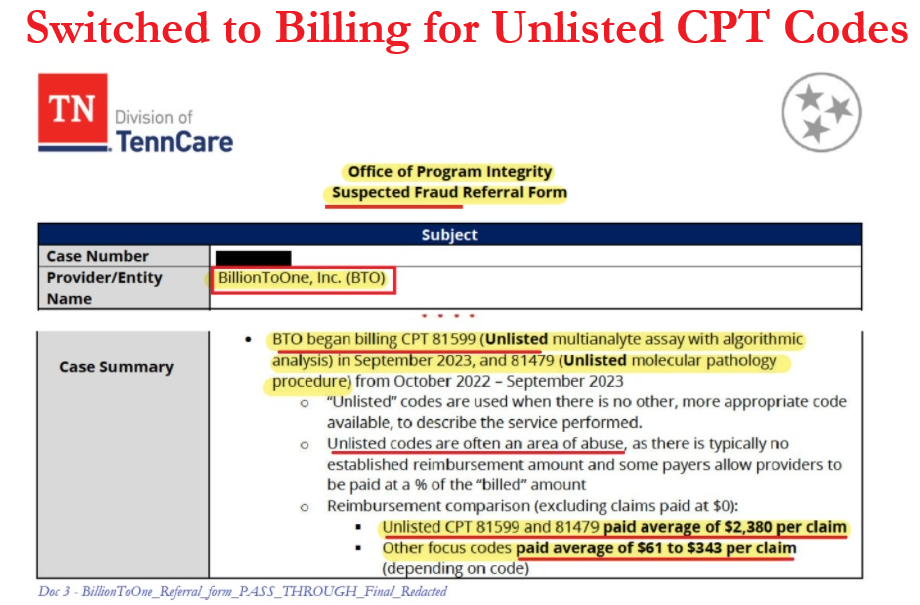
Source: Tennessee – OPI Suspected Fraud Referral Form (pg1 & pg4)
One Referring Provider Accounted for 27% of Total Paid Claims

Source: Tennessee – OPI MCC Audit Exposure Form (Pg. 2)
Error Rate of 100% for All 53 Claims Reviewed – All Found to be Unsupported Claims
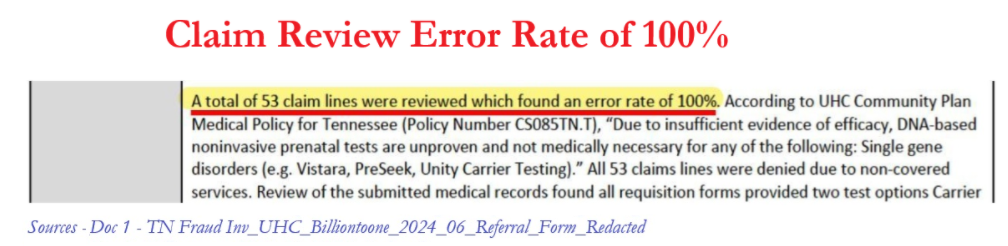
Source: Tennessee – OPI Potential Provider Fraud and Abuse Referral Form (pg. 3)
Violations of Medicaid False Claims Act alleged due to Billing for Unnecessary Carrier Testing
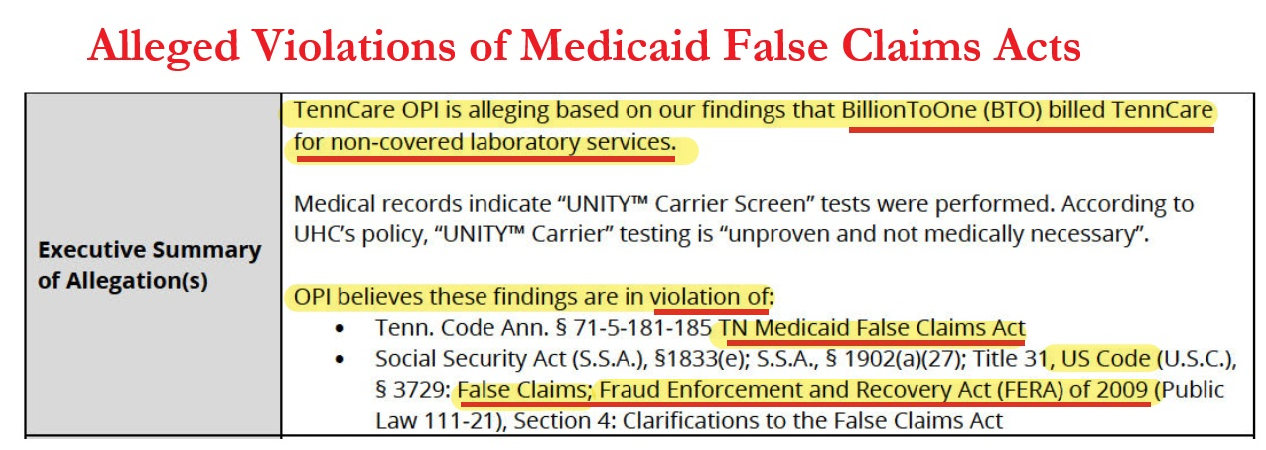
Source: Tennessee – OPI Suspected Fraud Referral Form (pg. 2)
From the documentation we were sent we can determine that the fraud inquiry by Tennessee’s Medicaid Fraud Division is still in process during early FY 2026 at the time of our public information request. It’s visible that the investigator is still actively added notes and new files to the case tracking system that same month as our FOIA request. This is important because under Tennessee law, all investigative records held by the Tennessee Bureau of Investigation (TBI) are strictly confidential and exempt from public disclosure, so we can’t FOIA and get additional documents from an active investigation. The official status shows up as being “MFCD Review,” which we believe means the “Medicaid Fraud Control Division” is still on the case, so we believe that the investigation is still either pending or is active and ongoing.
That said, investors should not be forced to guess the status of the Medicaid fraud investigation. Nor should they need to send public records requests to learn about them.
A suspected fraud investigation is something that management should be disclosing!
Michigan FOIA Data Indicates a Pattern of Fraudulent Billing for Carrier Tests
- Data Indicates BLLN Billed Medicaid for Carrier Tests ~170% More Often Than Competitors
- 120% More Than the Theoretical Max
- Former Reps Confirm the Suspiciously High Carrier Attachment Rates; It Raises “Red Flags”
Our FOIAs to the state of Michigan for Medicaid billing data regarding carrier testing and NIPT testing claims submitted by each company from 2021-2026 revealed that BillionToOne is billing for carrier testing at a suspiciously high rate. Patients are only eligible to get carrier testing once in their lifetime and only an est 39-40% of pregnancies are first time pregnancies. The data indicates BLLN is billing Medicaid for carrier tests at 2.2x the rate first pregnancies can explain. BillionToOne attempted to charge Medicaid for carrier screening 88% of the time!
This is important because submitting claims to Medicaid for medically unnecessary testing is illegal and violates federal and state laws. Billing for unnecessary testing is considered a False Claims Act violation.
BLLN’s 88% carrier attachment rate is 170% higher than their next highest competitor, Natera (32%), ~184% higher than Myriad (31%), and is even ~120% higher than the highest rate that appears to be mathematically possible based on how many NIPT tests run should be connected to 1st pregnancies (40%).
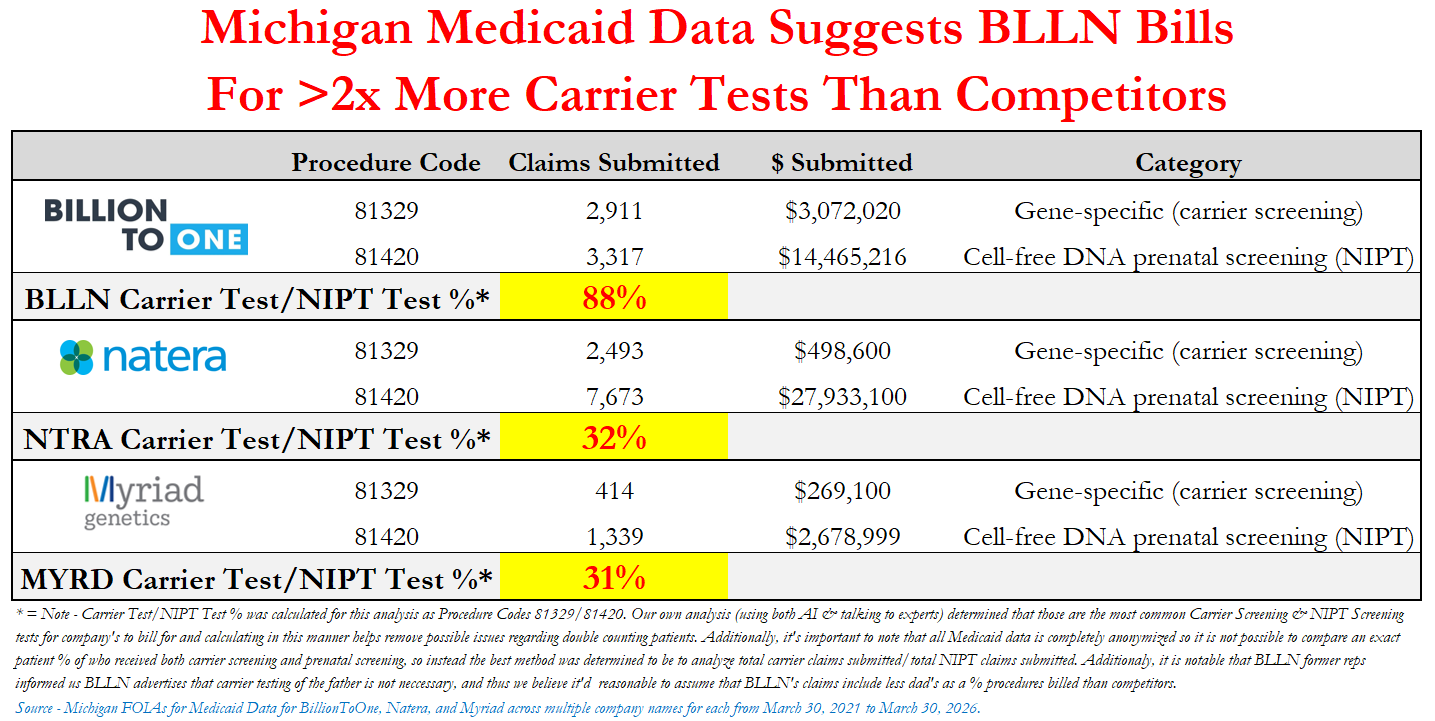
Source – FPR FOIA’s for Michigan Medicaid Data;
Note on Data – Company Carrier Test/NIPT Test % was calculated via dividing total submitted claims for CPT code 81329 (genetic testing for SMNQ gene dosage/deletion) / 81420 (NIPT test – Fetal Aneuploidy test of fetal DNA for chromosomes 13, 18, & 21). Medicaid data has patients anonymized so comparing total genetic tests billed for/total NIPT tests billed was what our research showed is the best way to calculate an approximated ratio.
The Medicaid data provides a rare datapoint into the billing that BLLN is submitting to Medicaid, which is a good proxy for what they are submitting to private insurers too.
Genetic Carrier Screening Should Only Be Done Once in a Lifetime
A genetic counselor explained to us in layman’s terms why you only get carrier testing once:
“You should never ever duplicate carrier screening… You never ever repeat carrier screening because your genetics don’t change. You were born a CF carrier, you’re still a CF carrier.” ~Prenatal Genetic Counselor M
Former Rep Said Some Regions Had 70-80% and 80% Plus Attachment Rates
A former BLLN employee confirmed the suspicions we had from the Michigan FOIA data and told us that some reps had carrier test attachment rates in the 70-80% rate all the way up to 80+% rate.
“I would say [carrier attachment rate] is…probably in 70-80% to 80% plus in some other regions…I think some people were really crushing it.” ~Former BLLN Sales Rep C
Sales Reps Pressured to Push More Carrier Screening:
Former BillionToOne sales reps told us they were pressured and incentivized to push carrier screening. A former rep told us that successful reps were able to “make the complete test the standard” and the company monitored their carrier “attachment rate” and reps were incentivized to increase the attachment rate because it was a “good money driver for the company.” One of the ways reps increased their carrier screening attachment rate was to push for doctors to primarily order the test as Unity Complete, which includes both carrier screening & aneuploidy testing, regardless of a patient’s carrier testing history and if carrier screening was medically necessary.
“There was a big push to try and get someone to do both aneuploidy and the carrier screening mainly from a sales perspective, it’s from a reimbursement and you’d get more credit if you were able to sell carrier screening. So there’s definitely a push to try and normalize like a combined aneuploidy and carrier as a package deal…I mean, at the end of the day, with all these things that’s coming down to it’s going to make the company more money…there was definitely pressure as a salesperson to push carrier screening” ~Former BLLN Sales Rep C
During our interview with another former sales rep we shared the state Medicaid carrier screening/NIPT test data rate of 88%. They told us that would raise “question marks” and “red flags.”
“88 to 90%, sounds to me, I would have red flags from that standpoint…I too would have some question marks….these would be red flags” ~Former BLLN Sales Rep A
We actually didn’t tell them which state would have such an unbelievably high attachment rate, and they guessed that it would’ve been in Alabama and they were utterly shocked when we said it was a midwestern state. Needless to say we have since submitted FOIA’s for BLLN’s Medicaid data from the state of Alabama (as well as multiple other states too).
PART II – Financial Impact – Short BillionToOne (BLLN)
Excess Carrier Tests Artificially Boosting EBITDA – Est >80% of EBITDA at Risk & >$1.2 Billion in Potential False Claims Act Penalties
- Crack-Down on Excess Carrier Test Billing = Est >80% Potential Drop in EBITDA; ~$73 Million of EBITDA At Risk of Going Away
- Potential False Claims Act Penalties Could Be >$1.2 Billion
Michigan Medicaid data indicates a mathematically improbably high carrier test attachment rate (88%) for BLLN, and former BLLN Reps further confirmed that reps had attachment rates in the 70% to 80+%.
We attempted to quantify the financial impact if BillionToOne lost the excess carrier tests, and we uncovered that reimbursement for excess carrier tests could account for between 55-160% of EBITDA. Our base case estimates show that $88 million (20%) of BLLN’s LTM revenue is at risk of going away if the alleged excessive carrier testing was stopped. Since the incremental added testing has high margins, we believe it’s extremely accretive to profits and a crack-down could result in EBITDA declining anywhere from $45m to $130m. Our base case guesstimates show EBITDA DECLINING by $~73m that’s >80% of EBITDA LOST.
In the extreme worst case BLLN EBITDA margins would drop all the way to -11.5% margins, and the elimination of excess carrier testing would wipe out an est ~$133 million, and the optimistic case is still disastrous with an estimated ~$45m of EBITDA so 55% of LTM EBITDA gone.
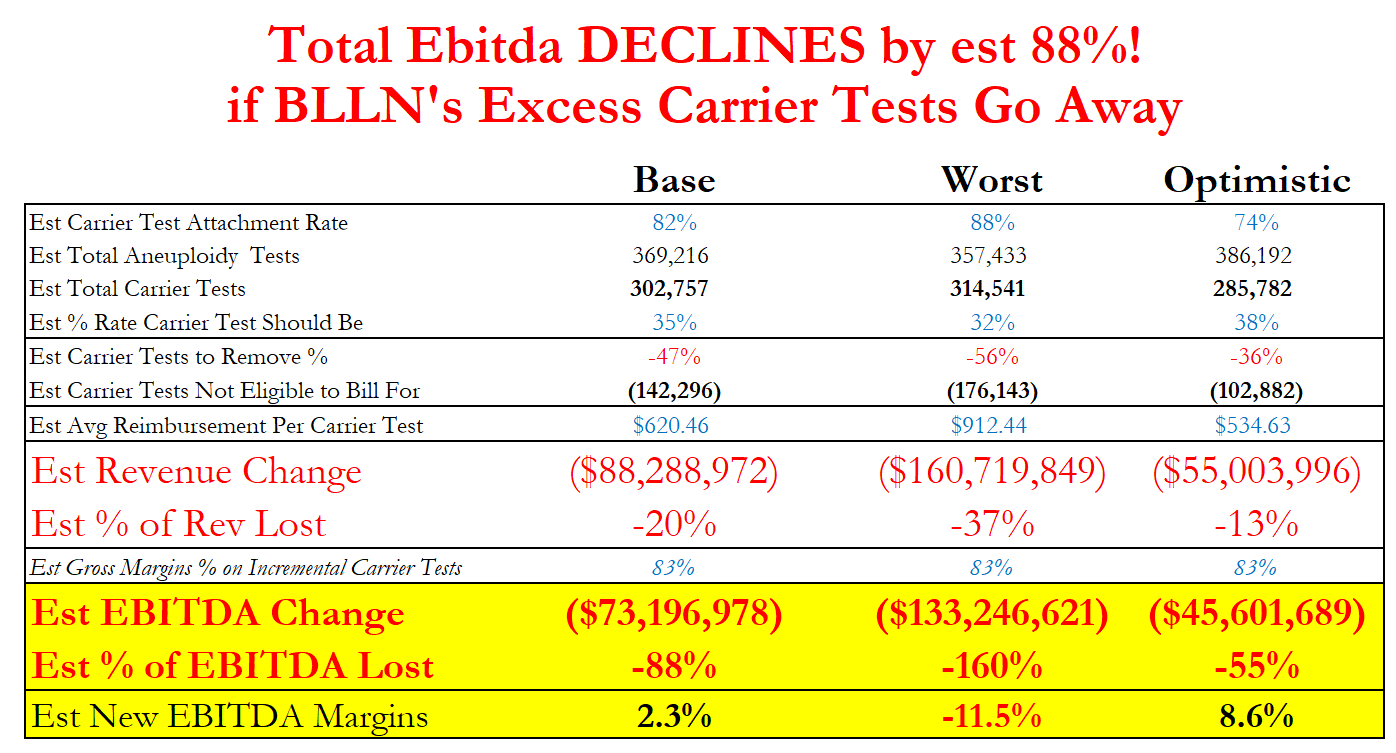
BillionToOne has provided very limited disclosure, which makes estimating the potential impact of losing a large % of carrier tests incredibly difficult, but it’s not impossible. Especially with the help of FOIA data + some lawsuits v insurance co’s (BillionToOne v. Elevance) where BTO appears to have accidentally provided too many details. Please see Appendix C for all the key assumptions we made for the above estimates.
False Claims Act Penalties For Excessive Carrier Testing Could Reach >$1.2 Billion
We can use more back of the envelope math to determine the potential size of False Claims Act Penalties that BillionToOne could face from submitting duplicated and unnecessary carrier tests to Medicaid based on the standard fine size. Extrapolating the Michigan Data across the US allows + basic math shows that the estimated False Claims Act Fines could be >$1.2 Billion.
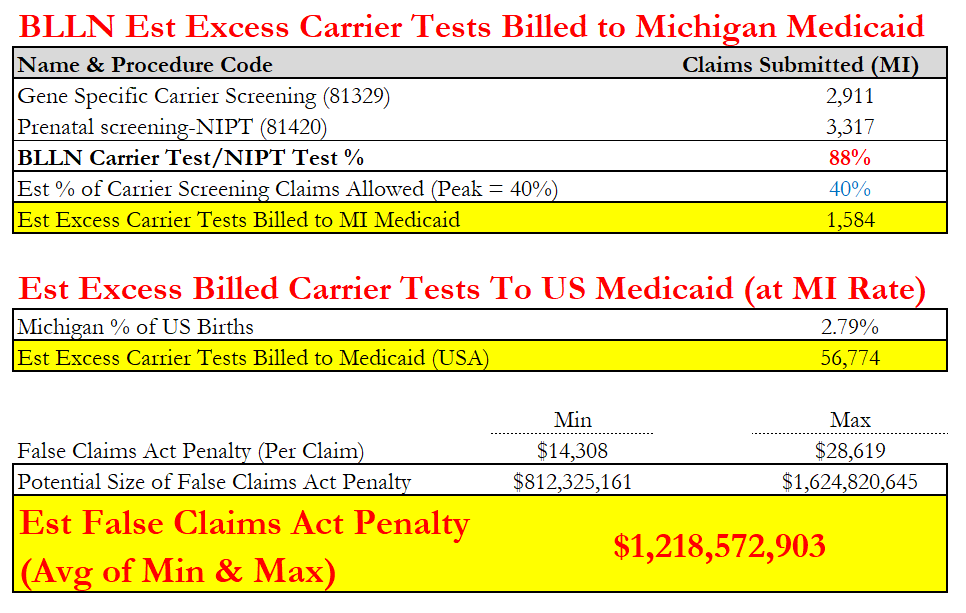
Assumptions & Estimates:
- Any Carrier Tests greater than a 40% genetic carrier test/aneuploidy nipt test rate = Potential False Claims Act
- In MI (2,911- (3,317*40%)) = 1,584 potential False Claims from Michigan alone
- CDC data shows from 2021-2024 MI accounted for an avg of 2.79% of all US births
- Assume MI 88% Carrier/NIPT test nationally = est 56,774 excess submitted to Medicaid across the US
- Current Min penalty = $14,308 & Max penalty = $28,619 per claim; so Avg = $21,463.50
- Est 56,774 excessive carrier tests * $21,463.50 = 1,218,572,903
Note that this ~$1.2 Billion number does NOT include any reimbursement to the government for financial losses suffered by the government. Those would actually bring additional fines as the government charges fines that are 3 times the actual financial loss suffered by the government. Additionally, it’s important to note that submitting a false claim to Medicaid (even one that Medicaid denied & didn’t pay) still results in the $14,000 -$28,000 penalty per false claim submitted.
We think that False Claims Act fines >$1 Billion would send BillionToOne’s valuation from multiple billions to < $1 real quick. Maybe the company’s name choice was meant to be foreshadow what will happen to its stock price?
Note – the above is only back of the envelope math for illustrative purposed only and does not represent the actual size of any future fines. It’s up to government regulators, the DOJ, and to the legal process to determine if any False Claims Act Fines are warranted, and if so what the size of those fines should be.
PART III – Patient Assistance Program Exposed – Short BillionToOne (BLLN)
Illicit Patient Assistance Program Exposed: Capping Deductibles & Co-Pays w/out Income Verification = Illegal Kickback?
Routinely waiving, capping or forgiving a patient’s medical deductible or copay generally constitutes health insurance fraud and abuse under federal and state laws. According to AI, capping co-pays or deductibles is a financial incentive to steer patients toward a specific medical test/practice and is generally considered an illegal inducements & kickback’s.
According to a former executive the company’s financial assistance program is “against the law.” They told us if the program was ever scrutinized by the law it’d be considered a “Stark violation” because “it’s inducement.”
“There’s a financial assistance application and program. The company [BillionToOne] will set what kind of discounts they want…it’s generous…it’s running against the law…it’s egregious, it’s too much. If it was scrutinized by the law, it would be considered a Stark [violation]…It’s inducement.” ~Former Senior BLLN Executive F
- Interviews with former BillionToOne reps & executives
- Interviews with practitioners who currently use BillionToOne’s Unity Test
- Recorded sales pitches by current reps
- Actual documents passed out by current sales reps to doctors’ offices
- But the facts are hiding in plain sight in online reviews by patients
We have uncovered evidence that BillionToOne has engaged in illicit deductible & co-pay caps without income verification via:
There is a direct precedent for what investors can expect to happen to companies in the NIPT space that engage in business practices like co-pay caps, waiving deductibles, etc. Progenity paid $49 million in 2020 to resolve allegations for fraudulent billing and kickbacks.
“Do whatever you can to get some momentum. If that means, hey, we’re going to zero out this bill just to make the clinic feel comfortable…Just let’s zero out the bill…It was like, no hesitation if this patient has a billing issue. Do whatever you can to make it as painless and easy for the clinic as possible.
“Generally speaking, [BillionToOne] felt to me a little less ethical… Adjust these bills as much as possible as needed. Say whatever it takes, do whatever it takes.” ~Former BLLN Sales Rep C
Former Employees & Medical Professionals Told Us BLLN Promises to Cap Deductibles – Isn’t that Illegal!?!
Deductibles are set by individual insurance plans not the companies who are conducting a medical diagnostic test. Routine caps on deductibles are not allowed and we were told were violations of Stark Laws and Anti-Kickback laws.
“The max out-of-pocket when I walked into BillionToOne, and I heard it every day because I would talk to patients myself personally every day, almost every day … they had trained their doctors that the max out of pocket was like 250..That is, excuse my language, bullshit. The ones that are honoring that are breaking Stark (laws)… the sales reps go out and be like, oh no, there’s no patient responsibility…or Max is 250…you can’t do 250.” ~Former Senior BLLN Executive F
Nurse practitioners that order BillionToOne’s Unity test said they were told the patients’ responsibility was capped at $199.
“There is a (Unity) pamphlet that we do give to patients… it’s explained to us is, hey, patients should not pay more than this amount ($199).” ~Nurse Practitioner Using Unity – L
A former BLLN sales rep confirmed that they would often get bills reduced just to ensure that key doctors and their patients were happy.
“I would write my manager and be like, hey, here’s, I’ve attached this bill for your review. I’d maybe have some context, hey, this is a really key doctor. And it’s important that we don’t have any friction in here. I’m looking to get this bill approved to go to $99 or go to $0 or anything like that. And they would pretty much always approve that stuff.” ~Former BLLN Sales Rep C
Documents Posted in a Doctor’s Office Expose BLLN’s Illicit Income Assistance Program (No W2s & No Proof of Income Required)
W2s and proof of income are almost always an eligibility requirement for a medical financial assistance program to be above board and executed legally. Below is a document that a BillionToOne sales rep posted in a doctor’s office with the selling points for BillionToOne. It even had the sales rep’s card and personal details posted on the document. The document states that “No W2 or additional paperwork is required to qualify” for BLLN’s financial assistance program.
Explicitly telling doctor’s and nurse’s that you are not going to verify income for your financial assistance program is similar to the type of patient kickbacks that got Progenity in deep trouble.
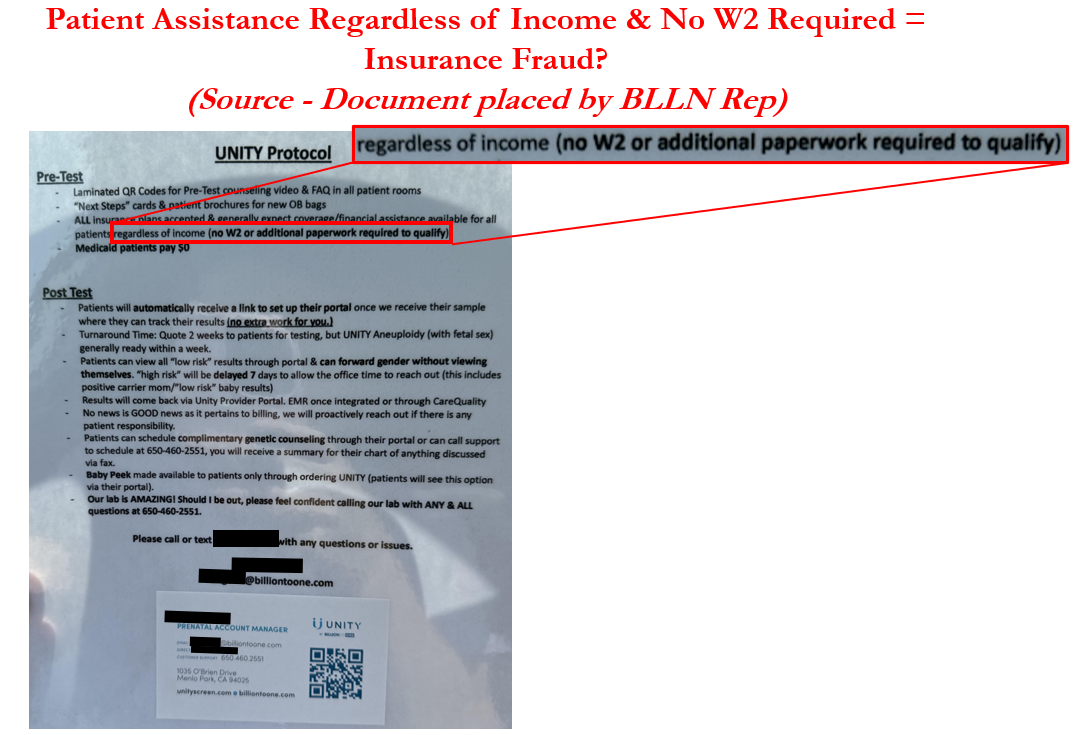
We learned from the office staff that this same rep additionally told them “patients do not receive bills from BTO because [they] have all the balances written off.” The office staff said they challenged the legality of this “shady tactic,” and the BLLN rep said this happens “throughout my entire territory and that [BillionToOne] do not balance bill patients.”
Companies can use patient assistance programs to reduce costs for low-income patients, but it becomes insurance fraud when companies illicitly use the programs to cap insurance deductibles and reduce co-pays without proper income verification. That becomes inducement.
Another Sales Rep Caught Via a Secret Recording – “We Don’t Verify Income Class, No W2’s”
A recording by an ob-gyn office staff of that was shared with us caught a BLLN sales rep promising that BLLN doesn’t verify income when describing their financial assistance program. This appears to be a very explicit violation of the Anti-Kickback Statute.
- No Income Verification Required (no W2s or anything like that)
- Financial Assistance Program that gives >$100,000 income families bill reductions
“We have an extremely robust financial system…we have seen six digit household income families receive bill reductions…the nice thing is we don’t verify, we don’t do anything like that…we don’t verify their income class, with W2s or anything like that, and right then and there they’ll get a reduction.” ~BLLN Sales Rep X – Secret Recording during Q2-2026
Audio Clip of the Sales Rep Promising No W2s, No Income Verification
Online Reviews Show BLLN’s Promises to Cap Deductibles – They Call BLLN a “Medical Billing Scam”
Social Media Posts Show:
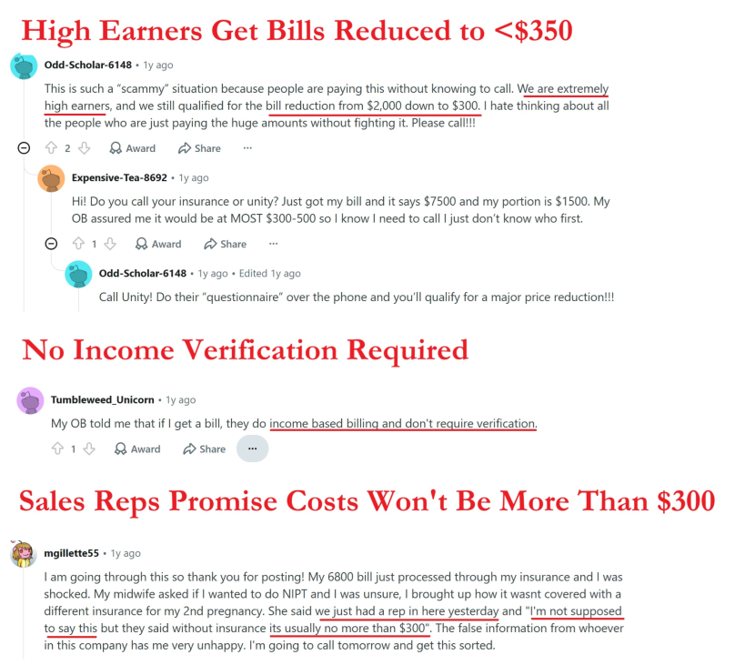
- High Income Patients Still Get Bills Reduced
- No Income Verification Required
- BLLN Sales Reps Make Promises for Deductible Caps
You don’t even need to gather secret documents from sales reps or interview former employees to find evidence of BLLN engaging in capping deductibles. It’s hiding in plain sight in reviews on Reddit and on BBB. Social Media posts are all of the place which start with surprise massive bills and then pivot to showing that BLLN’s Finance Office tells patients that their financial responsibility is capped.
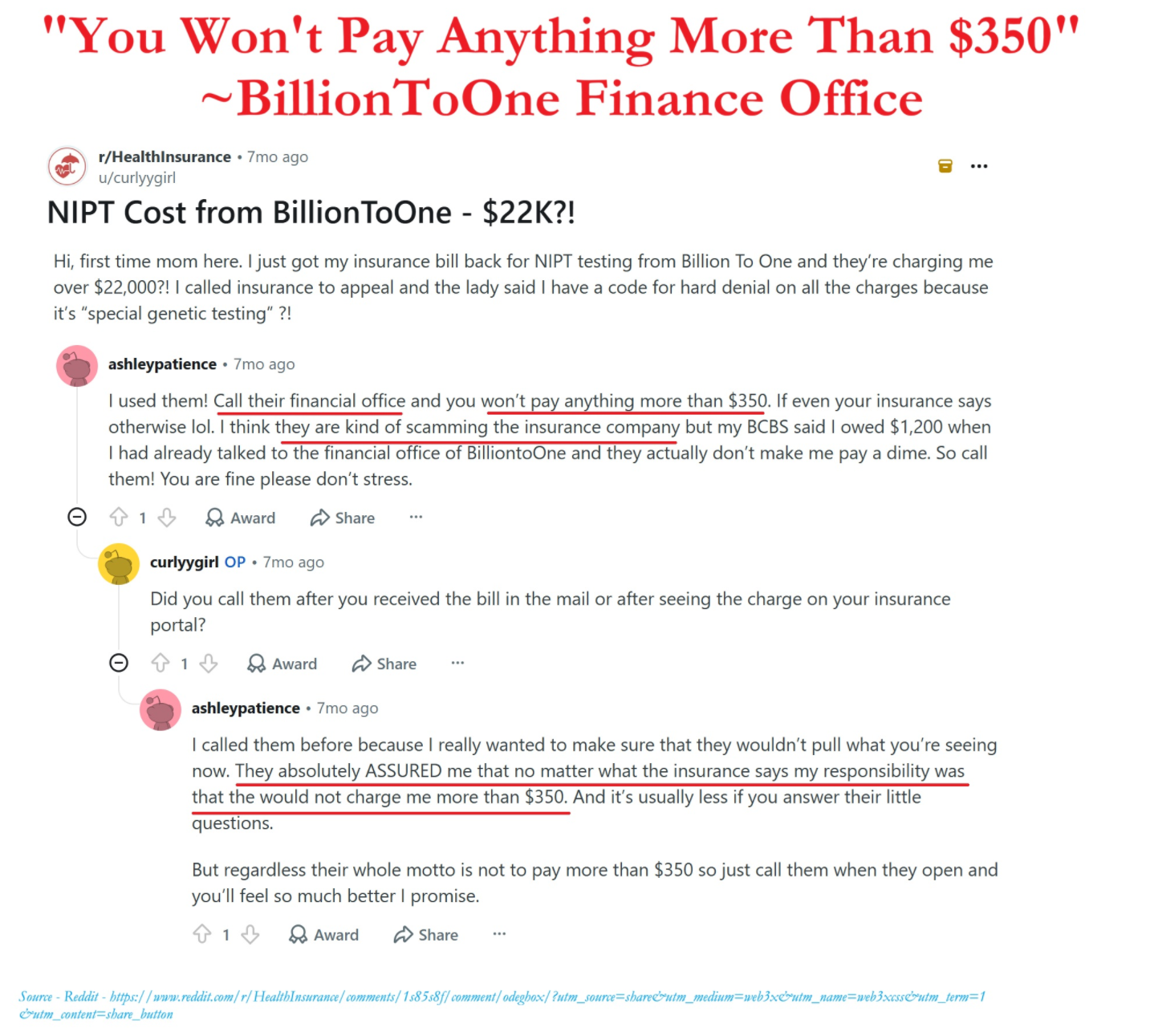
We have learned that in different states and regions different reps promise different caps. In some states it’s $99, others $149 or $199, and still others it’s $349.
But here are more Social Media Reddit Testimonials (1, 2, 3) showing the deductible capping appears to be hiding in plain sight.
There is even a Better Business Bureau Review where in the same review it shows BLLN’s promises of deductible capping for between $0-$200 and then BillionToOne follows up and takes it step further and responds that they zero’ed out the deductible bill for the patient.
Here are some more BBB Review’s (BBB 1, 2, 3, 4) which highlight BLLN’s Sketchy Practices. BillionToOne’s deductible capping program is hiding in plain sight, in fact they aren’t even bothering to hide it. Complainants come to the conclusion that we think you should’ve by now: “This is a medical billing SCAM!”
BTO Recruited Sales Reps From Progenity – Progenity Paid a $49 Million Settlement for Fraudulent Billing & Kickback Practices
The fruit of the poisonous tree often doesn’t fall far from its parent. It’s less surprising to learn that many of BillionToOne’s suspect sales practices mirror those of Progenity Inc when you learn that a significant portion of BillionToOne’s sales reps used to work at…Progenity!
LinkedIn shows 33 current & former BLLN reps previously worked at Progenity Inc. That’s an estimated 14% of the current sales force.
Progenity was a women’s health genetic testing lab focused on prenatal testing that paid a $49m settlement for allegedly engaging in fraudulent billing federal healthcare programs for prenatal tests and providing kickbacks to physicians.
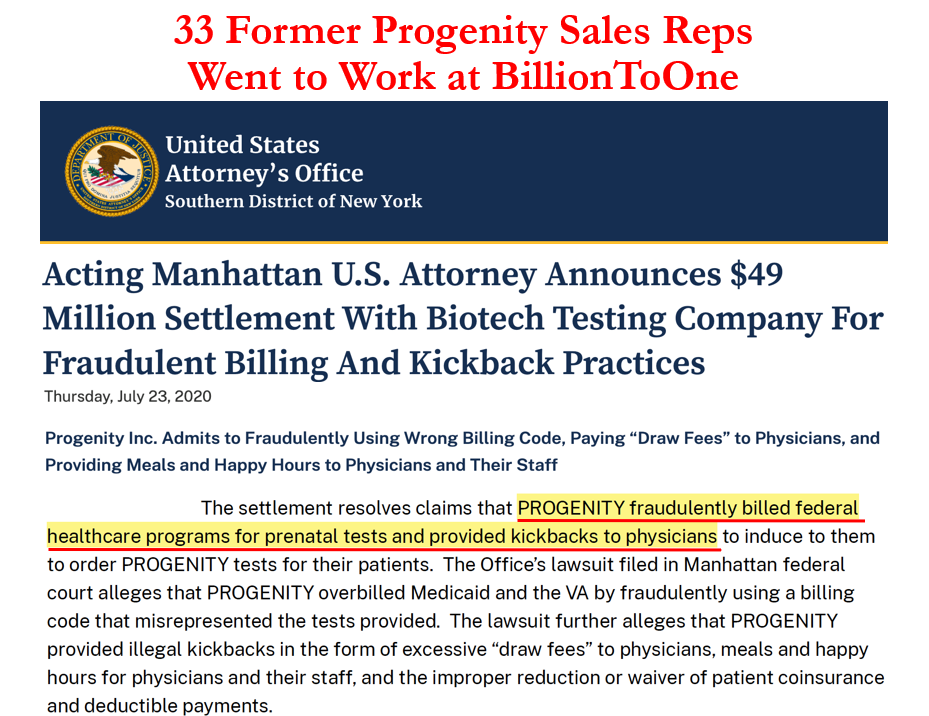
Source: Justice.gov
VP of Reimbursement & 8 Other BLLN Employees Worked at Sequenom – Sequenom was Accused of Schemes Including Price Capping
BLLN’s current VP of Reimbursement previously worked at Sequenom. There are actually 9 current BTO employees who previously worked at Sequenom. Sequenom was accused implementing a price capping scheme where they would bill private insurance $2,700 for it’s down syndrome genetic test and then cap a patient’s price at $230 (or sometimes $0). Once the price capping scheme was halted, test volumes and revenue plummeted.
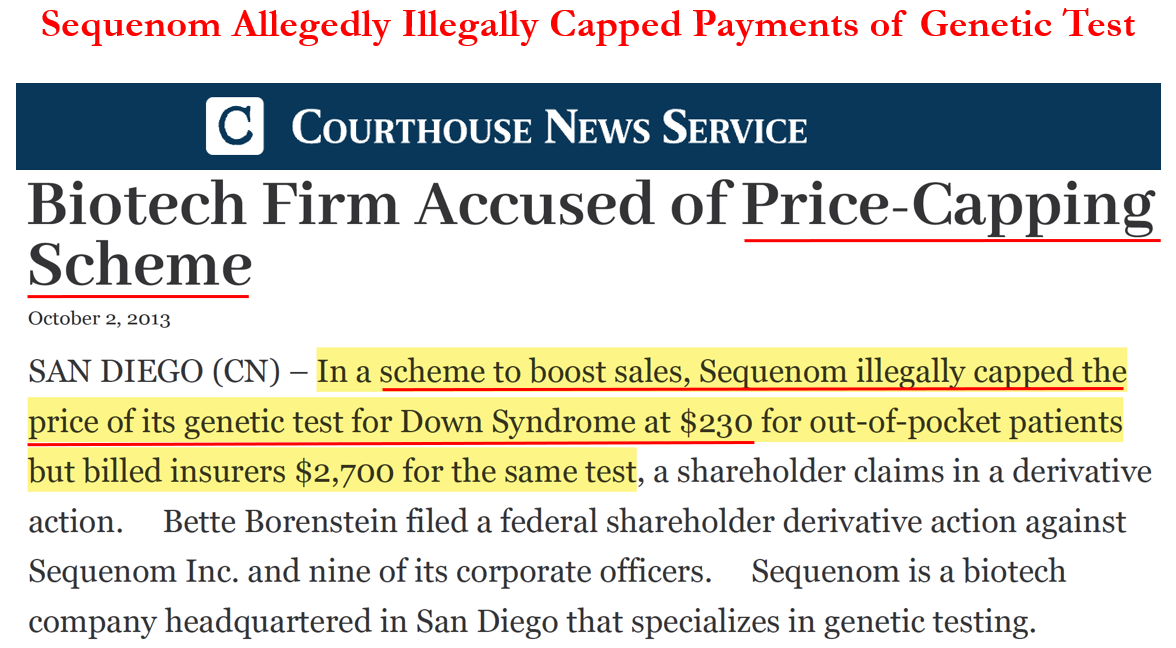
Source: Courthouse News Service
Also, in a full ironic round-trip the SEC and DOJ charged Sequenom’s former VP of R&D for False Claims about their Down Syndrome test being more accurate than it actually was. They claimed it had almost 100% accuracy, and when that was proven false, the stock plummeted by ~76%.
We find that ironic because, hmm…doesn’t BLLN also claim a 100% sensitivity rate…we promise you will enjoy the BLLN’s Hidden False Negatives section later in our report.
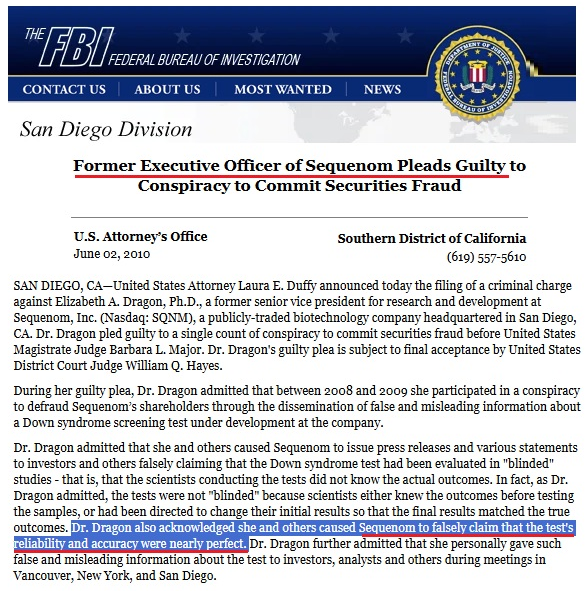
Source – FBI San Diego Division Press Release
PART IV – Oncology Broken Dream – Short BillionToOne (BLLN)
Oncology Product is a “Commodity” & a “MeToo” – New Study Relies on “Cherry Picked” Data
- Northstar Response – Doctors Say it’s a Me-Too Product that’s Not Differentiated
- Drs Report Results Have Been Unreliable
- Northstar Select = Drs & Formers Say it’s a “Commodity Business”
- 4/5 Doctors Have Cut Usage or Recommend other Tests to BLLN’s; For the 5th Northstar is 3rd place
- Oncology Studies Flaws – Adding Back “Cherry Picked” Data Drops Results from 94% to a 73%
One of our largest concerns for the BLLN short thesis was the future potential for BillionToOne’s Oncology products. At first we were worried, well at least that was until we started talking to oncology doctors and former BTO Senior Executives.
After talking to lots of experts and formers we have realized BTO’s oncology business is one where Wall Street has false hopes and dreams that don’t at all match the on-the-ground truth. Dr’s referred to Northstar as a me-too product that some have already stopped using and a former BLLN C-suite executive even called Northstar Select a “commodity business.”
False oncology hopes are what make up a lot of BLLN’s nose-bleed 12x P/Sales multiple.
Myriad just sold their NIPT business for ~1.3x P/Sales ratio. So if we put BLLN’s NIPT business at a more generous 2x P/Sales ratio (BLLN’s growing at an avg QoQ rate of ~+6.5% in FY 2026 vs. Myriad’s biz at an avg QoQ rate of -4.3%). Then Prenatal would be worth ~$765m and oncology worth ~$4.5 Bn aka Oncology is trading at ~90x P/Sales…which is insane for a business that industry experts call a “commodity” and say has is “not very differentiated.”
Once You Try Northstar Response – You go Right Back
We learned that Northstar Response is basically the white guy in the long-time sexual innuendo. Once you go White, you go right back to Black (Natera or Tempus). Doctor’s we spoke with that tried Northstar Response generally told us that they either stopped using it or had cut back their usage because Response tests results jumped around a lot and some experienced situations where the results didn’t match what they were seeing in their scans.
For response it’s clear to us that practicing oncologists all think tumor informed tests are significantly better. Doctors we spoke with told us that they preferred Natera’s Signatera, Guardant, or Tempus, and some sung praises for newer tests like Personalis which was acquired by Tempus in June 2026.
After hearing all the negative commentary on Northstar response we felt bad for them, so as a stylistic change we will present some of the lukewarm positive quotes about BTO’s Response before we reveal the negative ones:
Lukewarm Positives About Response – “It’s my #3;” “I don’t think it’s inferior…it’s not very differentiated”
- “The BillionToOne (Response), I would say, is probably my #3.” ~Oncologist – Physician S
- “80% of the time it’s accurate. If it’s going up, you know, as a trend two times in a row or more, and then likely the cancer is truly progressed. But not 100% of the time. Sometimes in some patients I see up and down, up and down. It’s just we have no idea why it’s going up and down” ~Oncologist – Physician R
- “I don’t think that it is an inferior assay… the problem that I’m seeing is it’s not very differentiated…And we physicians, we are not going to change vendors just because some Assay is promising a 0.1 increment in the sensitivity or specificity” ~Oncologist – Physician S
- “One of the other guys is still using Northstar…but he’s kind of the least academically inclined, the least interested in science. Oncologist – Physician N
Negatives About Response include “It’s Worthless”; “Trusting the BTO Test Would’ve Harmed a Patient”
- “I think [Response] it’s a worthless test…” ~Oncologist – Physician N
- “BillionToOne [Response] told him your lady must be doing very, very well…when she was actually doing very poorly.” ~Oncologist – Physician S
- “Last year I ordered a lot of Northstar…for treatment response monitoring…this year it actually goes down a little bit…I’m using Guardant for tissue sequencing so I just keep using [Guardant] for those patients.” ~Oncologist – Physician P
- [BillionToOne] are a me-too kind of company. So they’re trying to get their foot in… But the practical value for a treating physician at this time is much less.”
- “All of the other thoracic folks have stopped doing the, the BillionToOne response test” ~ Oncologist – Physician N
- “The [response] test is not correlating that well, so I don’t see how you can use it for treatment decisions…If we had ignored the scans and trusted the BillionToOne test, we would have done the patient a significant harm.” Oncologist – Physician N
Northstar Select – Former C-Level BLLN Ex’s Think it’s “a Commodity;” Oncologist’s Call it “Not that Compelling”
Commodity businesses don’t trade at 90x P/Sales, but that’s exactly what a former c-level executive from BillionToOne called their Northstar Select business.
“On the [Northstar] Select side, the test is really the same as every other test… it’s a commodity.” ~Former Senior BLLN Executive H
Another doc told us that Northstar’s pitch of higher sensitivity isn’t compelling and that other tests were better and more sensitive.
“On the select, they say they can be more [sensitive], but it’s like 0.15% [VAF] instead of like 0.2%. It’s not that compelling to me…I think the other tests are better, I mean, more sensitive.” ~Oncologist – Physician N
Oct 2026 Oncology Study Has Basic Flaws – “Cherry Picked” Data & Removed Cases where BLLN Had Worse Results
Imagine telling a teacher that you would like to retroactively remove all the questions you failed to answer correctly from a test. Your grade would obviously improve; it might even flip from C to an A. And that C would stand for “cherry picking.”
For the BillionToOne Response v. Natera’s Signatera Oct 2026 study, we paid an oncologist to review the study, its methodology, and let us know their honest thoughts on it. The Dr explained that they saw BTO engage in suspect methods like “cherry-picking” data to improve their own results and noted a large flaw that they BTO compared themselves to an older version of Natera’s test.
In the expert’s words:
“I think it’s clear to me that [BillionToOne] wanted to find a particular outcome and they went and found it. So, I think that the in terms of the correlation, it seems that they have done a little bit of cherry picking. They don’t have a ton of data points in the first place and then they ignore a big number of cases where Signatera says that there’s no or negative results.” ~Oncologist – Physician N
“BTO Throwing out the Negative Calls in Their study is a Big Deal”
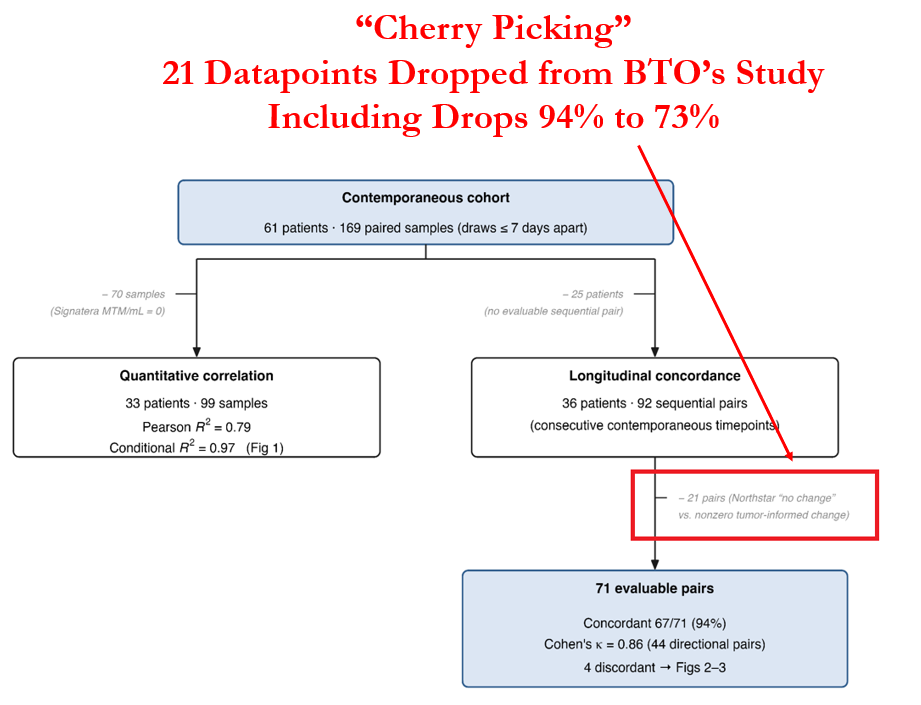
The details are buried in an Appendix. Reading through the appendix will burst BTO’s claims of being just as good as Signatera’s tumor informed test. We learned that BTO’s dropped 21 pairs where Northstar claimed “No Change” vs the tumor informed competitor seeing a change. BTO decided to remove their competitors negative calls which an expert told us was “a big deal.”
Including the additional data would have dropped the concordance rate from 94% to 73%
Old Version of Natera’s Signatera Used for Comparison in Study:
Two oncologists pointed out to us another obvious flaw in the study—BTO is comparing itself against an old Signatera test.
“The biggest limitation that I see in this second paper… is that they use an older version of Signatera test. You can see in the table one that they say… bespoke up to 16 loci…They’re comparing their assay against an older version of the Natera assay, whereas Natera’s again is moving one step ahead.” ~Oncologist – Physician S
PART V – Undisclosed BabyPeek & Deceptive Marketing – Short BillionToOne (BLLN)
Deceptive Marketing – Doctors Call BLLN’s Marketing Misleading & Sleazy
BillionToOne Claims They have 100% Accuracy
BillionToOne’s marketing materials expose that the company would market an internal clinical study that shows “100% accuracy in clinical studies.” How is it possible to be 100% when you’re a screening test, not a diagnostic?

In September 2025, BillionToOne again stated their screening test had 100% sensitivity and that no CF pregnancies were missed. What they must’ve forgotten to state is that they only received replies for ~6.4% of the low-risk cases. And the 100% sensitivity was later proven to be wrong because they missed a false negative.

Doctors have told us they have issues with the marketing of 100% because it’s misleading and can result in physicians passing along bad information to their patients.
“BillionToOne advertising is very aggressive, and doing some things that are frankly sleazy.” ~Academic ObGyn V
“If you slap that number in all of your marketing materials without like a clear like, oh, this is just in this population, but not in different population. I think that’s misleading.” ~ObGyn – Physician K
BabyPeek – BLLN’s Undisclosed “Sleazy” Secret that Drives More Carrier Testing
The words “Baby Peek” are listed ZERO times in BillionToOne’s SEC Filings. BabyPeek is undisclosed and hidden from investors. In fact, the only find we could find BTO management acknowledging that the Baby Peek program even exists was back in a March 2024 article announcing BabyPeek had launched.
Why are they hiding it? There clearly is reason why management doesn’t talk about BabyPeek publicly.
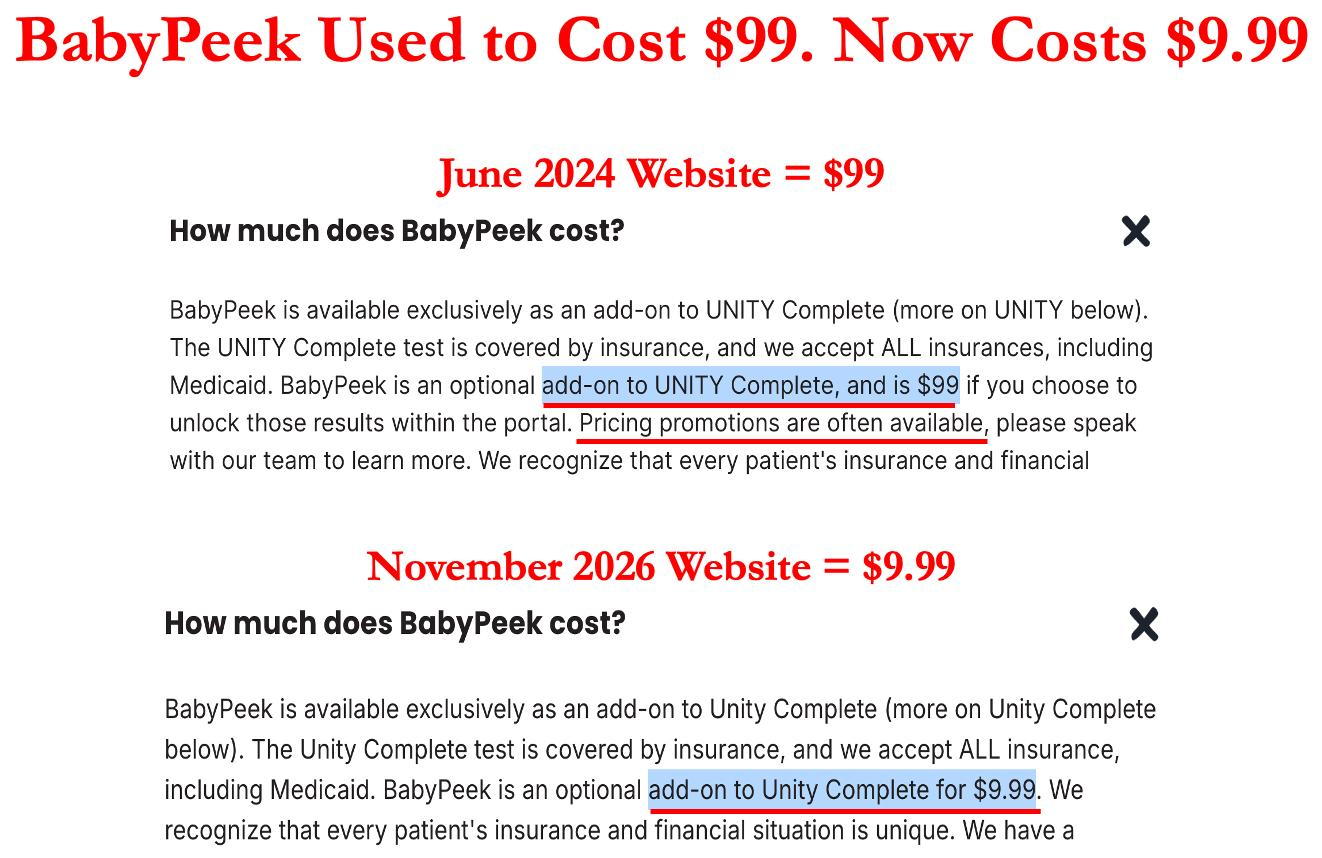
We think BabyPeek is a $9.99 gimmick that relies on non-medical based incentives to encourage more carrier testing which enables BLLN to bill as much as $7,000+ for some carrier tests that medically never needed to be ordered (especially for 2nd pregnancy’s). Former sales reps told us BabyPeek helped them get a “bump in volume.”
Interviews with Ob-gyn’s, genetic counselors, and former sales reps informed us that that doctors and genetic counselors think:
- BabyPeek is “sleazy,”
- “inaccurate and gross,”
- and “not appropriate.”
When we brought it up in an interview with one genetic counselor, they actually told us “ugh, don’t make me barf.”
So What is BabyPeek? & Why is it Viewed as Sleazy?
Former BLLN sales reps told us that BabyPeek is a marketing tool to lure people into getting more carrier tests done. BabyPeek promises to not only let you know the not only gender of your baby, but also features like eye color, curly hair, if your baby will dislike cilantro, etc (Note – cilantro is gross, FPR thinks that people who love cilantro should look into upgrading their genetics, jk, actually no we aren’t).
BabyPeek is viewed as a “sleazy” marketing tactic because it is a novelty feature that has no medical clinical value but is marketed as only being available to patients who have done UNITY Complete (both carrier testing & NIPT testing). This bundling is especially unethical when it’s being sold to a woman in a 2nd pregnancy who has already had carrier screening in a prior pregnancy.
Legal Note – When those redundant tests are billed to Medicaid or other federal programs, the lure can look like an inducement to generate reimbursable services (Anti-Kickback Statute, beneficiary-inducement rules), and the claims themselves are for tests that aren’t medically necessary (False Claims Act exposure).
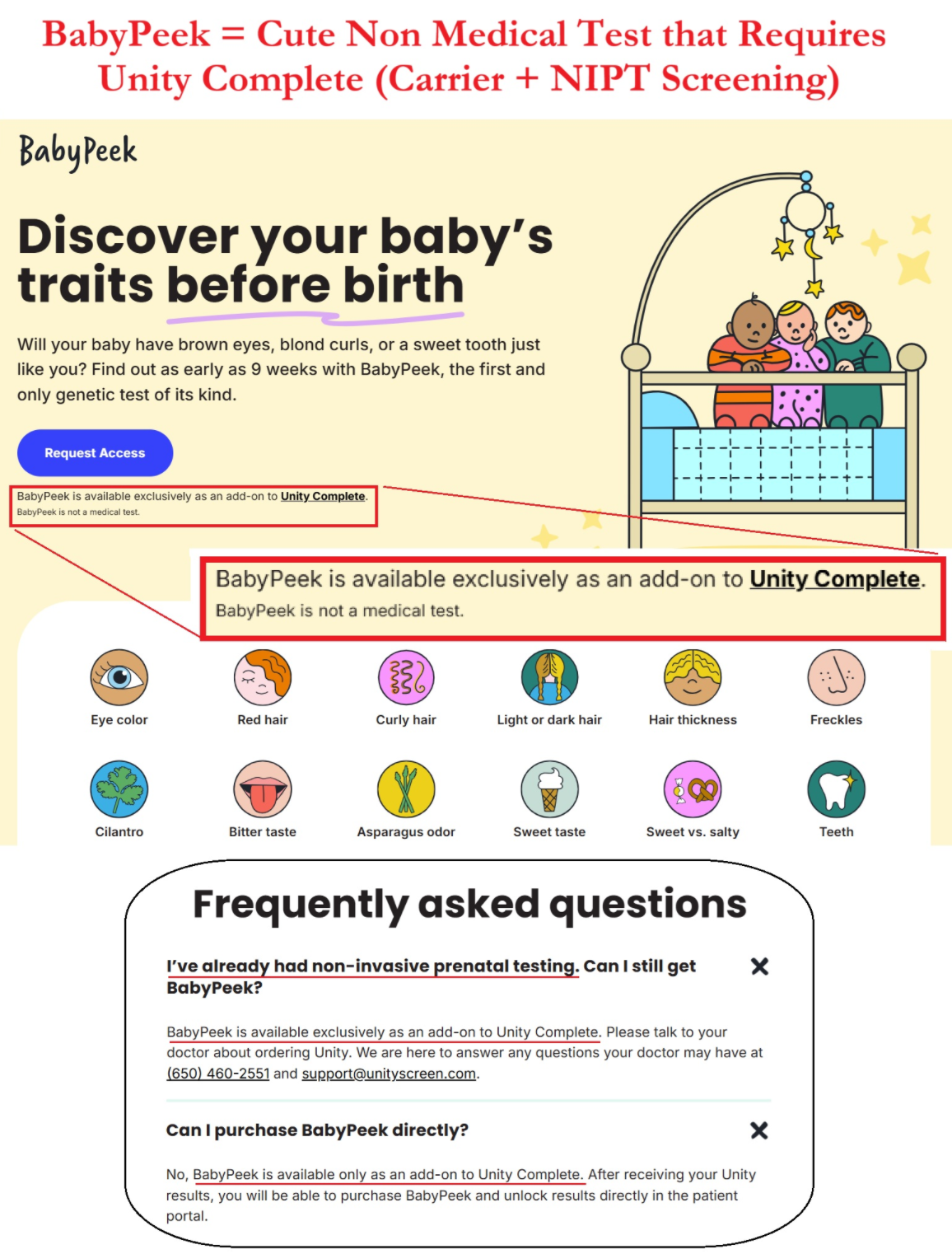
Former BLLN Sales Reps told us BabyPeek “drove a bump in volume.”
“The BabyPeek is actually pretty cool...We saw a bump in volume with that…people were pretty excited. I actually got a lot of baby peek. And mind you, I was dealing in in a very low-income area…It was always bundled with the bigger unity test…you know you’re trying to generate volume… if you want to use baby peek come use our test…You got a lot of business that way” ~Former BLLN Sales Rep B
Other former BLLN Sales Reps told us “BabyPeek” was important to sales because it got insurance to pay BLLN for the feature parents really wanted, an early gender reveal.
“People just want to know the sex of the baby. That’s 95% of what they care about… We would have people call in, they’d be like, why aren’t my results ready? I’m having a gender reveal party this weekend.” ~Former BLLN Sales Rep C
“Insurance isn’t going to pay because you want to know the color of your child’s eyes. But what (BabyPeek) did for BillionToOne was that was what people wanted more so than the necessary testing…the reason gain in popularity is because you can find out the baby’s gender. So in most cases, there’s been hundreds of thousands of patients over the last several years who just got this testing regardless what lab it was, because they wanted to know if the baby was a boy or a girl.” ~Former BLLN Operations Employee D
BabyPeek – Used to Cost $99 but Prices Dropped to $9.99 & Reports Show You Can Get BabyPeek For Free by Posting on Social Media
When BabyPeek launched, BillionToOne advertised that patients would have to pay $99 out-of-pocket to get the BabyPeek add-on. But by early 2025 BLLN dropped the price to $9.99. It makes sense to pretty much give the BabyPeek feature away since it primary purpose seems to be to drive more claims submitted to insurance and Medicaid rather than to make $ from the test itself.
Posting on Social Media = BabyPeek For Free?
Online posts also show BabyPeek is given away for free if moms promise to post about BabyPeek on social media. A genetic counselor on Reddit noted:

A former BLLN senior executive in finance explained that it incentivized bundled testing – even when the carrier testing – a component of the Unity Complete test – was redundant:
“They run immaterial tests that have already been assessed on the patient. There’s a big thing to get BabyPeek on a second pregnancy.” ~Former Senior BLLN Executive F
PART VI – Insurer Backlash – Short BillionToOne (BLLN)
Insurer Backlash – Insurance Co Halted Payments BLLN’s Proprietary Code For Carrier Screening
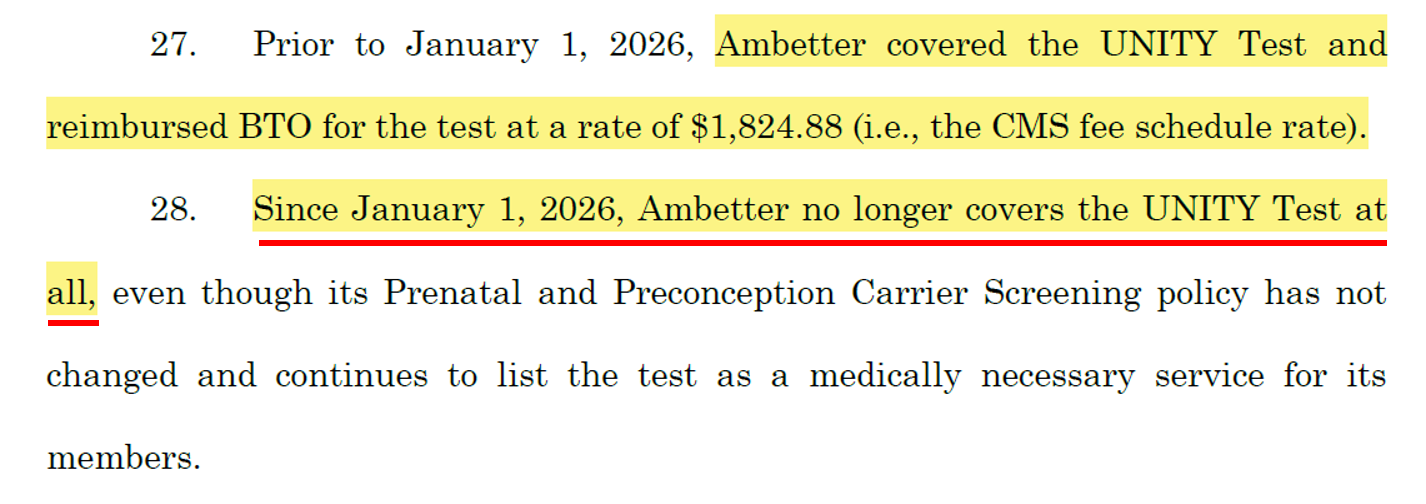
Ambetter Health, operated by Centene Corp, makes up an estimated 17-18% of the ACA individual insurance market. We uncovered that beginning in early 2026 Ambetter has stopped accepting Unity Complete proprietary code (0499U) to “help patients avoid unnecessary out-of-pocket costs.”
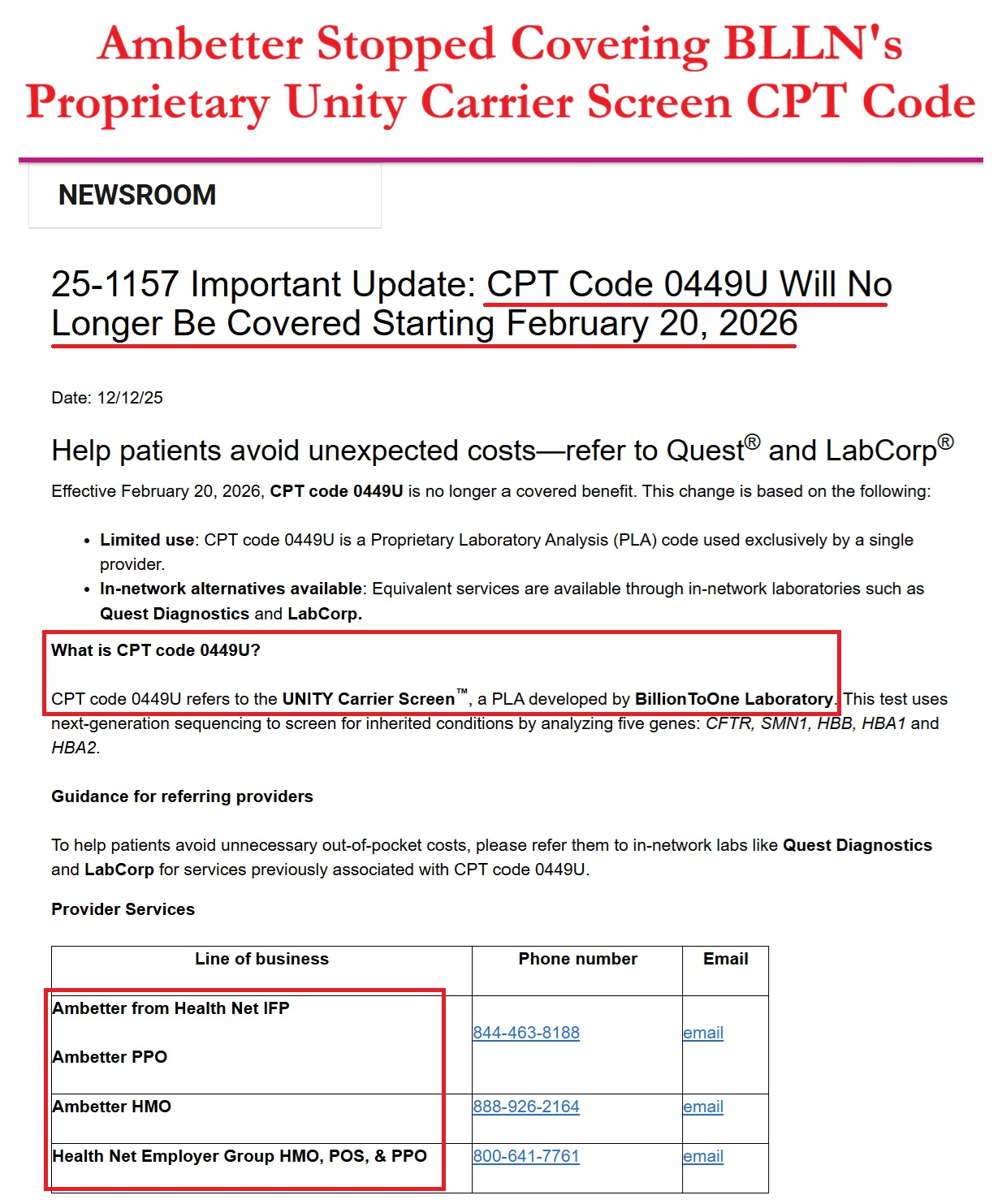
We suspect that BillionToOne’s aggressive marketing and billing practices around bundled testing – which leaves patients with unexpected out-of-pocket bills to either pay or negotiate down may explain Ambetter’s decision.
Elevance (owner of Anthem Blue Cross) Dropped Reimbursement to a Median of ~$9.12 in 2025
In 2025, BillionToOne sued Elevance, which revealed that Elevance (owner of Anthem Blue Cross) had started routinely denying BTO claims that were submitted and that for the claims that were paid the median reimbursement rate had dropped down to $9.12.
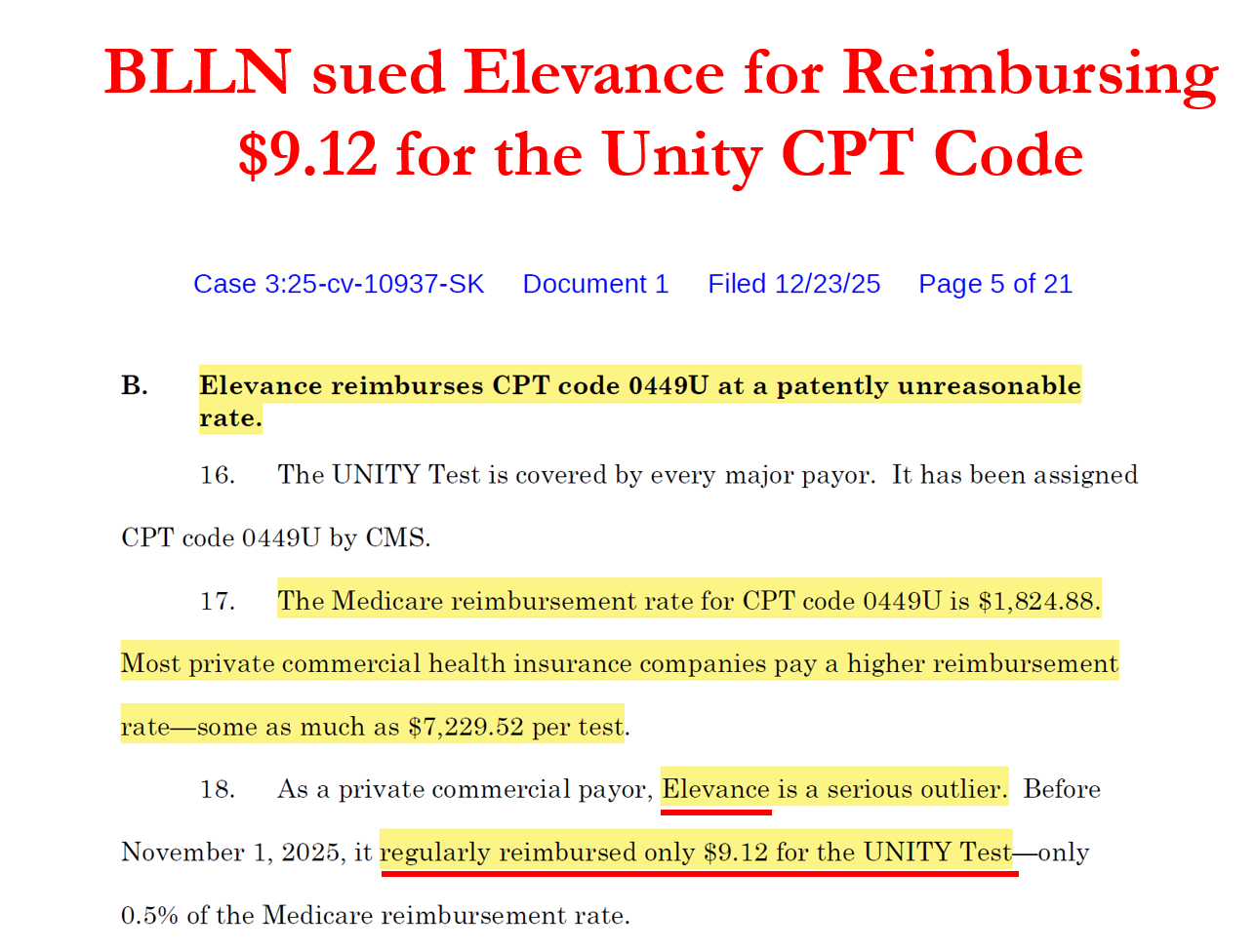
Source – BillionToOne v Elevance Health – Case 3:25-cv-10937-SK – Doc 1
Additionally, that lawsuit had some interesting claims data submitted with it. We learned that ~80% of the dollars Elevance allowed and paid BTO on CPT code 0449U in 2025 came from only ~6% of the tests. Additionally 27% of dollars reimbursed came from only 155 claims (0.8% of tests), which were allowed at four times the Medicare rate or more.
Ultimately the BillionToOne v Elevance dispute got resolved, and BTO announced that they brough Anthem in-network on the Q1 earnings call. However, when we spoke to an industry expert, they told us that the terms were likely not as favorable as both us and Wall Street expected. The expert told us that:
“Company’s like BTO often take it on the chin for reimbursement when a major insurance company comes in-network…the insurers are trying to extract a pound of flesh” ~Prenatal Industry Expert Y
PART VII – False Negatives – Short BillionToOne (BLLN)
Billion’s NIPT Test’s False Negative Problems
- Dr’s Sound the Alarm About BLLN’s False Negative Problem
- Odds 3 False Negatives in 1 Practice = 8 in 1,000,000 – Yet It Happened
- Interviews with Drs & Genetic Counselors Confirm Multitude of Unreported False Negatives
- Industry Expert Cites Examples of >120 False Negatives that they Heard Have Occurred
- Self Conducted Study Used “Cherry-Picked Data” + Had Basic Flaws:
- Tip for Cherry Picking Data – If You Don’t Follow Up, Then Patients Can’t Report False Negatives
“False negative is really bad because from a patient care perspective, false negatives say that, oh, your pregnancy is just fine… we would take the risk of false positive in the effort to reduce false negative.” ~ObGyn – Physician K
In NIPT testing for possible genetic disorders in fetuses, false negatives are the worst thing that could happen. A false negative is basically a missed diagnosis, it is when a genetic abnormality is calculated at low or very low risk and then the child ends up being born with that genetic issue. So simply it’s when a test fails. The result is disastrous because it result in child being born with a rare genetic disorders like Cystic Fibrosis, Fragile X, or Down Syndrome that should’ve been caught early in the pregnancy.
BillionToOne has made claims of having “100 percent sensitivity” for Cystic Fibrosis cases in marketing material sent to doctors. Sales reps have pushed the false narrative to doctors and patients that there is virtually no chance that BLLN’s NIPT test will be wrong.
These ridiculous marketing claims are what led a group of Colorado doctors to expose the truth: BillionToOne is hiding a false negative problem.
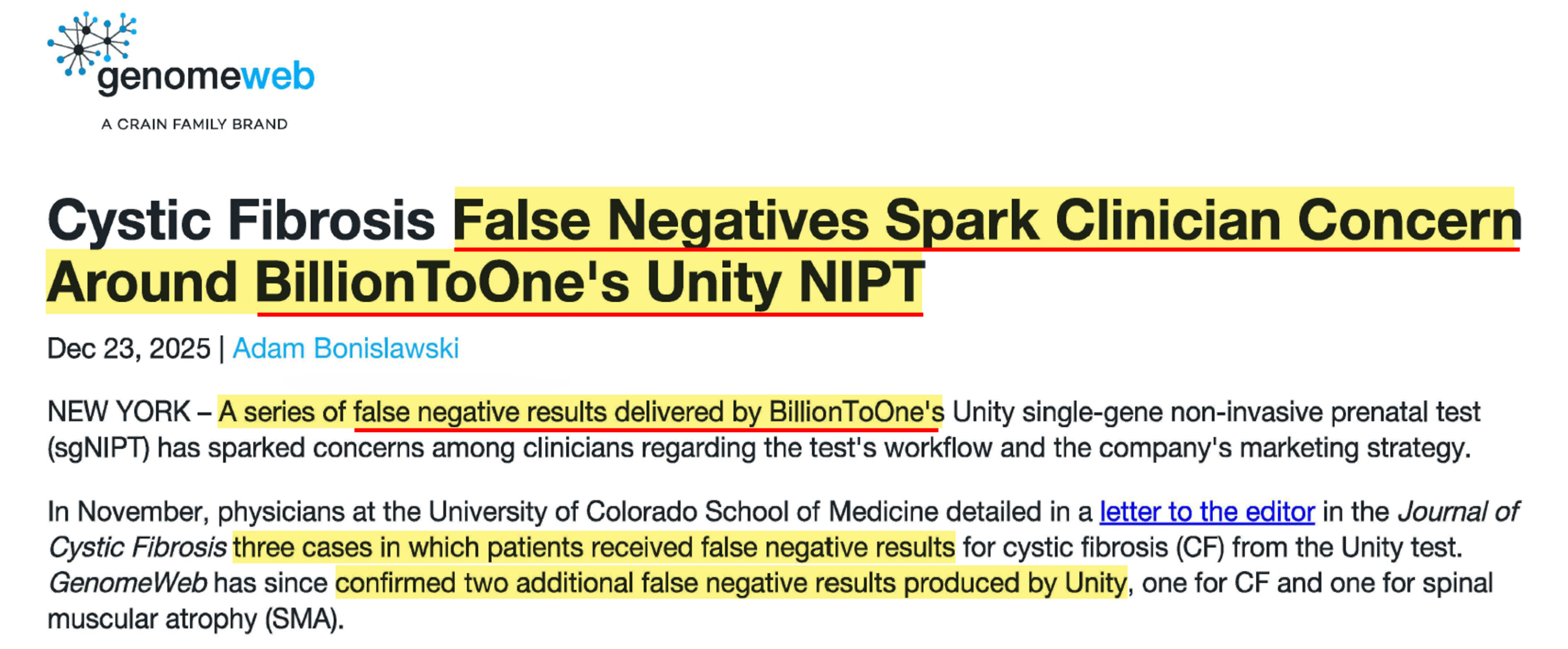
Source – GenomeWeb – Dec 23, 2025 (web archive accessible version)
The doctors exposed the false negative problem by sharing what they saw in their own practice. They experienced 3 false negatives first hand. Three infants who were listed as low-risk after BLLN’s sgNIPT test were later diagnosed with CF. The odds of this occurring from BLLN’s own probabilities according to the doctors at the lowest probability level was “8 in 1 million.”
One of BillionToOne’s Own Paid Medical Advisors Effectively Blew the Whistle on their False Negative Issues
- Dr who signed the 3 False Negative Letter was a Co-Author of BTO’s 2025 NIPT Study & a Paid BTO Medical Advisor
You know a problem really must be bad when you are getting exposed by a Dr that is one of your own paid medical advisors!
It get’s even worse when you realize that same doctor was a co-author on a recent March 2025 BillionToOne NIPT study. He was one of the few authors of that study who was not a BillionToOne employee
Dr. Michael Zaretsky is one of the 5 authors of the bombshell letter published in the Journal of Cystic Fibrosis that began a shit-storm of reported false negatives, but his own disclosures point out his allegiance, he discloses he has been a paid “medical advisor for BillionToOne.”
Dr. Zaretsky signing off on the letter to the editor of Journal of Cystic Fibrosis exposing false negative problems shows that BTO’s own advisors felt it was necessary to blow the whistle on them in the name of patient safety.
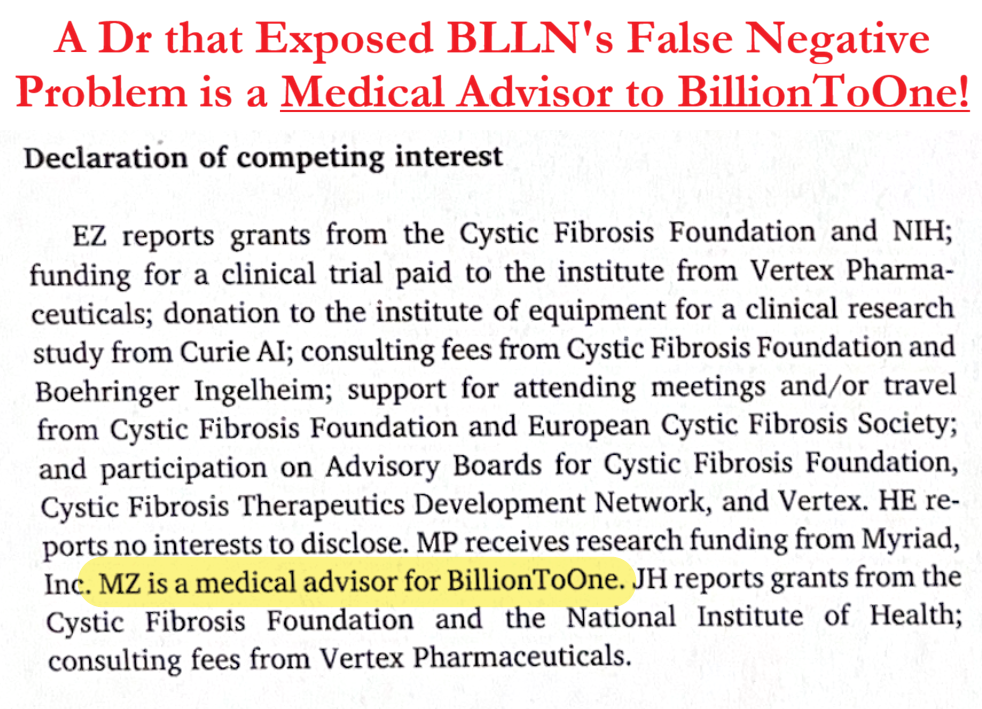
We interviewed with one the doctors that authored the letter to editor exposing the false negative problem. The told us that they wrote it because they thought it was important to raise more awareness for the “limitations of the testing” and because they felt BillionToOne’s “marketing material is misleading.”
NIPT Expert Informed Us of >120 False Negatives: they heard BTO Missed Lots Cystic Fibrosis & Down Syndrome Cases
An NIPT industry expert we spoke with informed us that they believed the False Negative problem for BillionToOne is actually widespread. The expert informed us that BillionToOne’s Unity Test has evidently resulted in more than 120 False Negatives.
“I know of at least 120 incidents of false negatives. There are probably way more out there that we haven’t even heard of yet. BillionToOne’s false negative problem is pervasive.” ~Prenatal Industry Expert Y
Which is way more than the 13 CF cases BLLN finally admitted to in a GenomeWeb article. The expert said they had heard of ~50 CF False Negatives.
Q) We heard there had only been 13 CF false negative cases, are there more?
“Yes, there are definitely more than 13 CF ones [false negatives]. I have personally heard of around 50 cases or more of CF.” ~Prenatal Industry Expert Y
They told us that a multitude of False Negatives have shown up for BillionToOne’s Unity on both the single gene and aneuploidy tests.
“Honestly, the false negatives we’ve heard reported are all over the place. Cystic fibrosis is the biggest one, ~40% of BTO’s false negatives we have heard of have been CF [Cystic Fibrosis]. But there are also missed Down syndrome cases too. Down syndrome was ~15% of the false negatives and in addition we have heard of lots of SMA, HBB, HBA, and even some T18 false negatives too.” ~Prenatal Industry Expert Y
And it’s not just the random one-off case. The expert said many practices reported experiencing multiple false negatives. There were even some practices that have seen as many as four false negatives.
“Look, one miss is horrible but is not impossible. But we have heard of practices reporting finding two three, and even four false negatives with UNITY. That’s not a 1 off miss, that’s clearly a pattern.” ~Prenatal Industry Expert Y
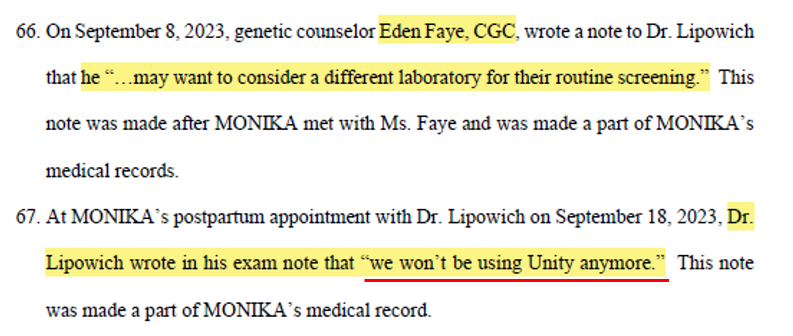
False Negative Effect – Dr says “We won’t be using Unity anymore.”
We think that doctors will likely slowly stop ordering the UNITY test as they stop trusting this test and begin to become concerned that the promises of no false negatives don’t match what they’ve seen clinically.
This is actually exactly what a complaint says happened in a missed Trisomy 18 legal case against BillionToOne. The doctor wrote, “We won’t be using Unity anymore.”
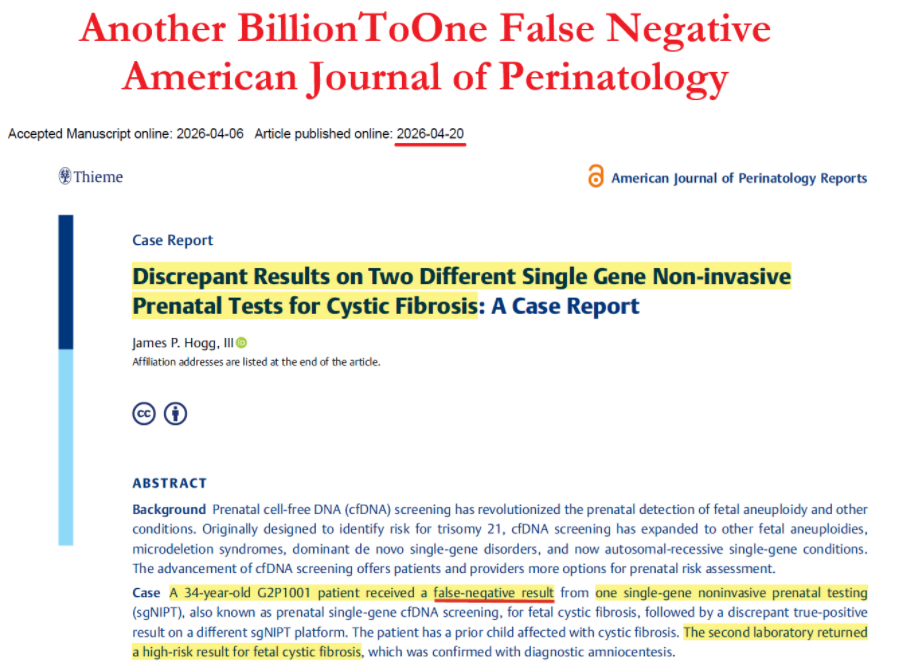
Another False Negative Reported in American Journal of Perinatology
More medical journals showing more BLLN false negatives—in this one, another false negative by the BillionToOne Unity Test was highlighted in an article in the American Journal of Perinatology Reports.
In this case, the BTO test came back with a “decreased risk” for CF and reported a 1/51 chance. Both partners were known carriers of the CFTR F508del, and the patient had previously had a child with cystic fibrosis (CF) so thankfully in this case, the patient requested another NIPT test to be done. The other NIPT test (Fetal Focus by Natera, another NIPT testing company) was done at 19 weeks and showed a high risk of CF and allowed the patient to begin treatment later in the pregnancy.
Genetic Counselors & Doctors Cited More False Negatives Too:
A doctor who was an author of the false negatives letter told us that they had heard of a multitude of other false negatives after those first reports came out.
“I personally have had like multiple [doctors] that came like, oh yeah, this [a false negative] has happened to me. This [False Negatives] has happened to me also.” ~Ob-Gyn – Physician K
It hasn’t been just these doctors at one practice. The anomalies seem to be showing up across the US; in fact, we think it appears to be a pattern.
“I’ve had enough false negatives…BTO throws out some false negatives that just should not be happening in 2026. I had a false negative Down syndrome and it just that should not happen. CPM with 21 is not a thing that should not happen.” ~Prenatal Genetic Counselor M
One ObGyn sent an email that they had seen a False Negative with BLLN’s Unity too.
“no false negatives…apparently, they missed the one in our practice.” ~Email from ObGyn
“I have seen substantially more false positives and negatives with BTO because they’re always in a hurry” ~Prenatal Genetic Counselor M
Holes in BLLN’s NIPT Studies Exposed:
- “Cherry Picked” Data
- Low Follow-up = Can’t Find False Negatives If You Don’t Look
- Excluded High Risk Couples
- Shocker – Most of Study’s Authors are BLLN Employees
You won’t find what you don’t look for.
Nine prenatal sources and former BLLN employees we interviewed criticized the evidence behind BillionToOne’s Unity Studies. From them we learned that BillionToOne appears to have designed their own studies as though they intentionally did NOT want to find false negatives.
“There’d be a lot of gaps in like BillionToOne [NIPT] studies… I don’t want to say manipulation of the data, but clever ways to present the data. Or cherry pick the data a little bit…if you dig deep, there can be holes poked in the BillionToOne data…it was not as robust.” ~Former BLLN Sales Rep C
Cherry Picked Data 101:
- Do Rigorous Follow-Up When Confirming Positives
- Limit Follow-Up when it Might Confirm Negatives by Using Text Msg only Survey’s for Some of the Data
It’s obvious that less rigorous follow-up would lead to less reliable results. We learned that low risk calls which could’ve led to false negatives consistently had less rigorous follow-up for patient outcomes in both the 2023/2025 Wynn et al BillionToOne studies.
For comparison – In the 2023 paper for the high risk results (which BLLN is incentive to confirm) BLLN’s quality assurance team contacted the ordering provider first, then the patient via phone, email and text if the ordering provider didn’t know. Now compare that to the collection method for lows risk negative outcomes: patients were only sent a text message survey.
So when BLLN’s wants to confirm something they proactively call a patient’s doctor, and if that doesn’t work they will hound the patient like a debt collector, and on the flip-side when it’s disadvantageous to disconfirm a low risk outcome, they send a spam text message.
Very few people are willing to respond to a text message survey, let alone one asking if they either had to terminate a pregnancy or had a still-birth, etc. Not surprisingly only 6.4% of low risk & decreased risk calls responded to the text survey.
For the 2025 paper results they didn’t even bother to spam everyone and instead only sent a text msg survey to ½ of the low-risk patient calls. From that study ~87% of the outcomes are unknown.
Experts we spoke with pointed out major study’s design issues because the NIPT test is inherently a test for a rare disease so when 86-94% of your low risk calls have unknown outcomes, that means you likely missed a lot of important false negatives.
When a genetic counselor heard BLLN present their study’s methodology, they told us they had to laugh, because the conclusions behind the 100% sensitivity and 99.9% specificity weren’t validated in way that they felt was scientifically rigorous.
“less than 20% of BTO was validated with genetic truth, meaning their follow up to see if they’re asking about it right or wrong.” ~Prenatal Genetic Counselor M
More Study Design Issues – BLLN’s Studies Exclude High-Risk Known Carriers:
Both the BLLN 2023 & 2025 Wynn, et al studies exclude patients who were part of a high-risk couple. The obvious flaw in this methodology is that BLLN’s Unity test markets that you do not need to test the father. So the test’s conditions don’t appear to match the real-world use case, since if a father was never tested then how would anyone know if they were a carrier?
Including the excluded patients would’ve hurt BLLN’s reported metrics and caused the PPV (positive predictive value) to change from 65% down to ~57%.
“And the studies that is some of the studies that are published, one of them (2023 study) exclude patients who are high risk. … they actually exclude people who are known to be carrier couples.” ~Ob-Gyn – Physician K
A former BLLN C-level executive explained that excluding high risk patients from the studies biases the data so false positive rate is higher.
“..if you don’t include the high-risk patients, then you don’t know what your false positive rate is, right?” ~Former Senior BLLN Executive J
BillionToOne’s Marketing Claims 99.9%/100% accuracy – is that a realistic Scientific Claim? – NO!
We asked a professor and ob-gyn who analyzed all the studies what they thought of BLLN’s claim from the studies.
Q) BillionToOne marketing claims 99.9% accuracy, which is basically they’re saying we’re 100% accurate as a selling point. Is it a realistic scientific claim?
“No no no no no no. That’s like the biggest problem. The biggest problem.” ~Ob-Gyn – Physician K
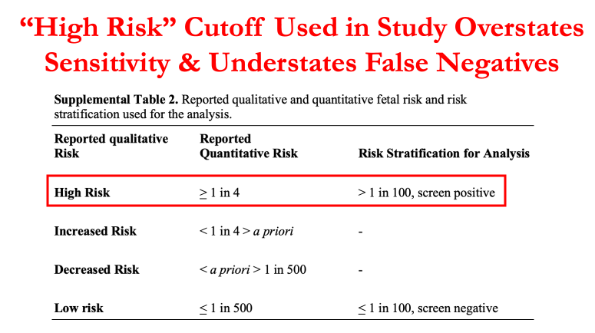
Another Issue – “High Risk” Cutoff Differs in Study vs. Real World = Overstates Sensitivity & Understates False Negatives
BillionToOne overstates their test sensitivity and understates the potential for false negative results by using a different cutoff in their published study and in the real world.
In their published study, a “high risk” result is considered anything greater than 1 in 100. This means when BillionToOne’s model thinks there is a chance of at least 1% that the fetus has a genetic disorder, they will classify that fetus as high risk. This leads to a high sensitivity because there’s a lower chance of missing a true affected pregnancy.
But in the real world they only classify results as “high risk” if their model thinks there’s a >25% chance the fetus could have a genetic disorder. So, in the real world, BillionToOne’s test has a lower sensitivity because as many true positives turn into false negatives as the threshold for classifying a patient “high risk” increased. Typically, a “high risk” patient will be sent to a Genetic Counselor for follow up. But when BillionToOne uses a >1 in 4 cutoff in the real world, fewer patients would be considered “high risk” leading to higher false negatives.
BillionToOne actually admits this, saying their sensitivity would decrease from 99.7% to 92% if they used a 1 in 4 stratification in their study. But unfortunately, physicians ordering BillionToOne’s UNITY test rely on marketing materials which are based on their published study.
Another Issue – Majority of Study Authors are Employees of BillionToOne
As a short-seller we get accused of not being objective all the time, so we get it.
But it’s hard to question if a study claiming a 100% sensitivity rate was really conducted objectively when the majority of the study’s authors are BillionToOne employees. 4 out of the 7 2025 Unity study authors were BTO employees including (BLLNs Director of Clinical Research, VP of Medical Affairs, a BLLN Genetic Counselor, and the CTO & Co-founder).
False Negatives Are Horrific & Can Result in a Baby Dying (Lawsuit)
Apologies to our readers as this report is lacking our usual quips and jokes, but that’s because there is nothing funny about dead babies. It’s horrifying and every parent’s nightmare.
That’s exactly what happened to one family because of a missed Trisomy 18 case by BillionToOne.
They were told that there was <1 in 10,000 chance of their son having Trisomy 18 and that the BillionToOne test has a false negative rate of less than .0001. As a result they did not push for any more invasive testing when some of the potential signs showed up on an ultrasound, because they were told they were low risk.
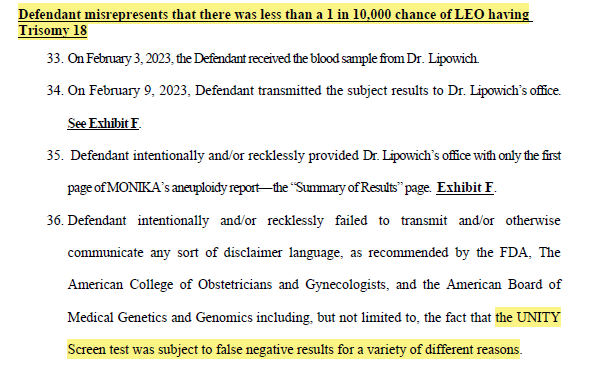
When their son was born, a blood test revealed he had Trisomy 18 and he passed away from it ~3 weeks later.
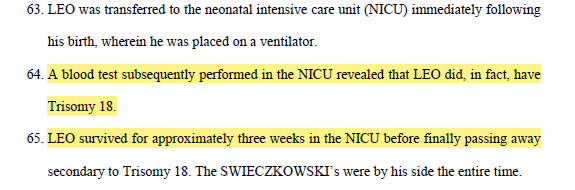
Only after their child’s death did they learn the False negatives rate for BLLN’s Unity test has been shown to be much higher.

PART VIII – Supplier Suing & Insiders Selling – Short BillionToOne (BLLN)
Key Suppliers – One Accuses BLLN of Patent Infringement & Suing for Royalties; Another is on DoD’s Chinese Military Co’s List
A former senior employee cited one of the largest risks to BLLN’s future economics as a patent infringement lawsuit from the company Illumnia. The former told us this lawsuit was the single largest risk to BLLN’s revenue from Unity because the result could be that BillionToOne is forced to pay Illumnia a royalty on every Unity Test that is done going forward.
Being forced to pay a significant royalty to Illumnia would obviously destroy BLLN’s current economics.
“BillionToOne has an IP infringement lawsuit from Illumina. I was surprised that there was no statement given in last quarter’s earnings call by BillionToOne around this lawsuit…Because it is definitely going to affect revenue. It is a single largest risk to their revenue from UNITY.” ~Former Senior BLLN Executive G
Specifically, the lawsuit says that methods Illumina created for measuring fetal DNA fractions in NIPT tests are being used without permission by BillionToOne.
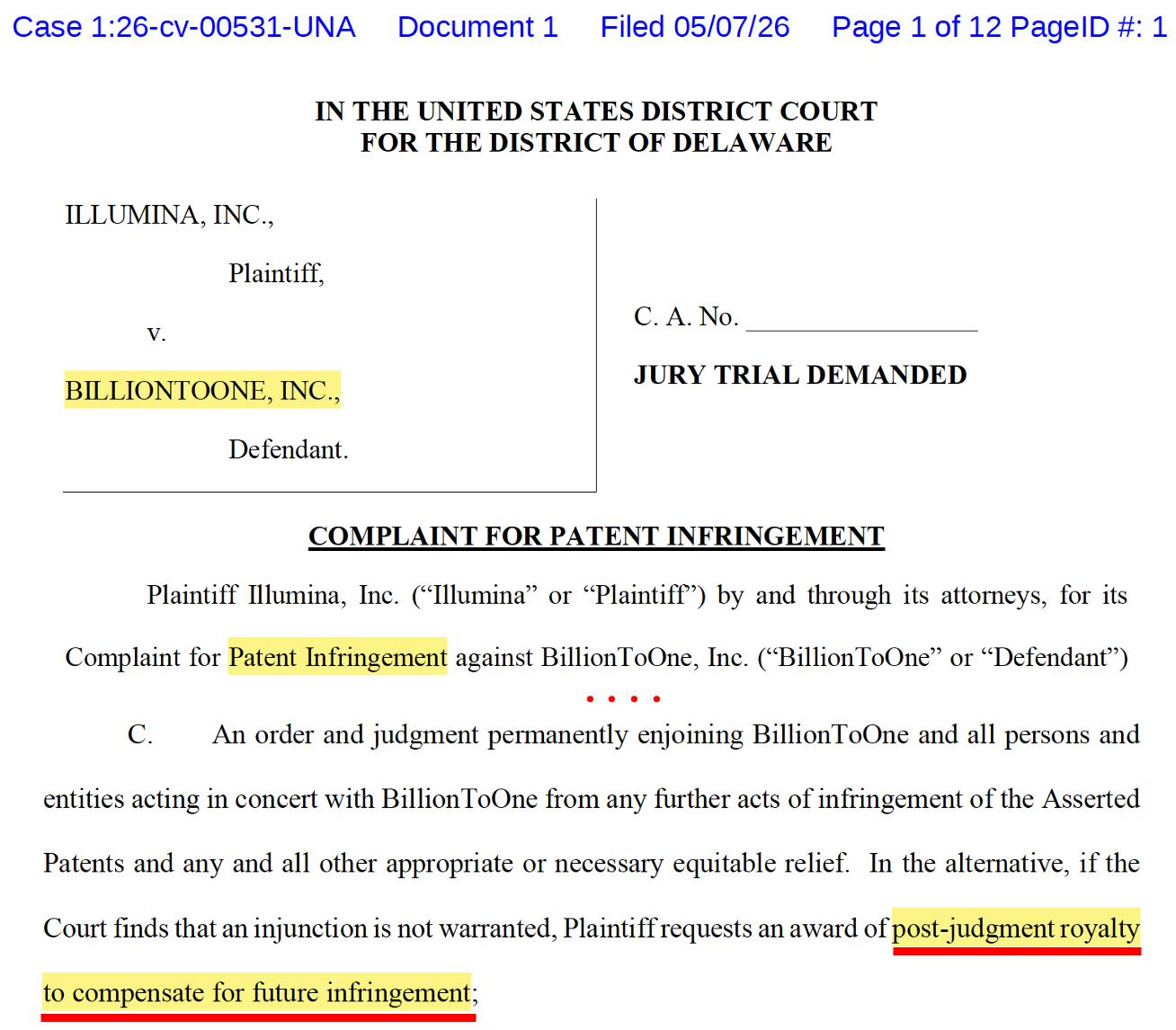
Interestingly, Illumina is listed as one of three main vendors used by BillionToOne to run its tests, according to the National Institutes of Health Genetic Testing Registry.
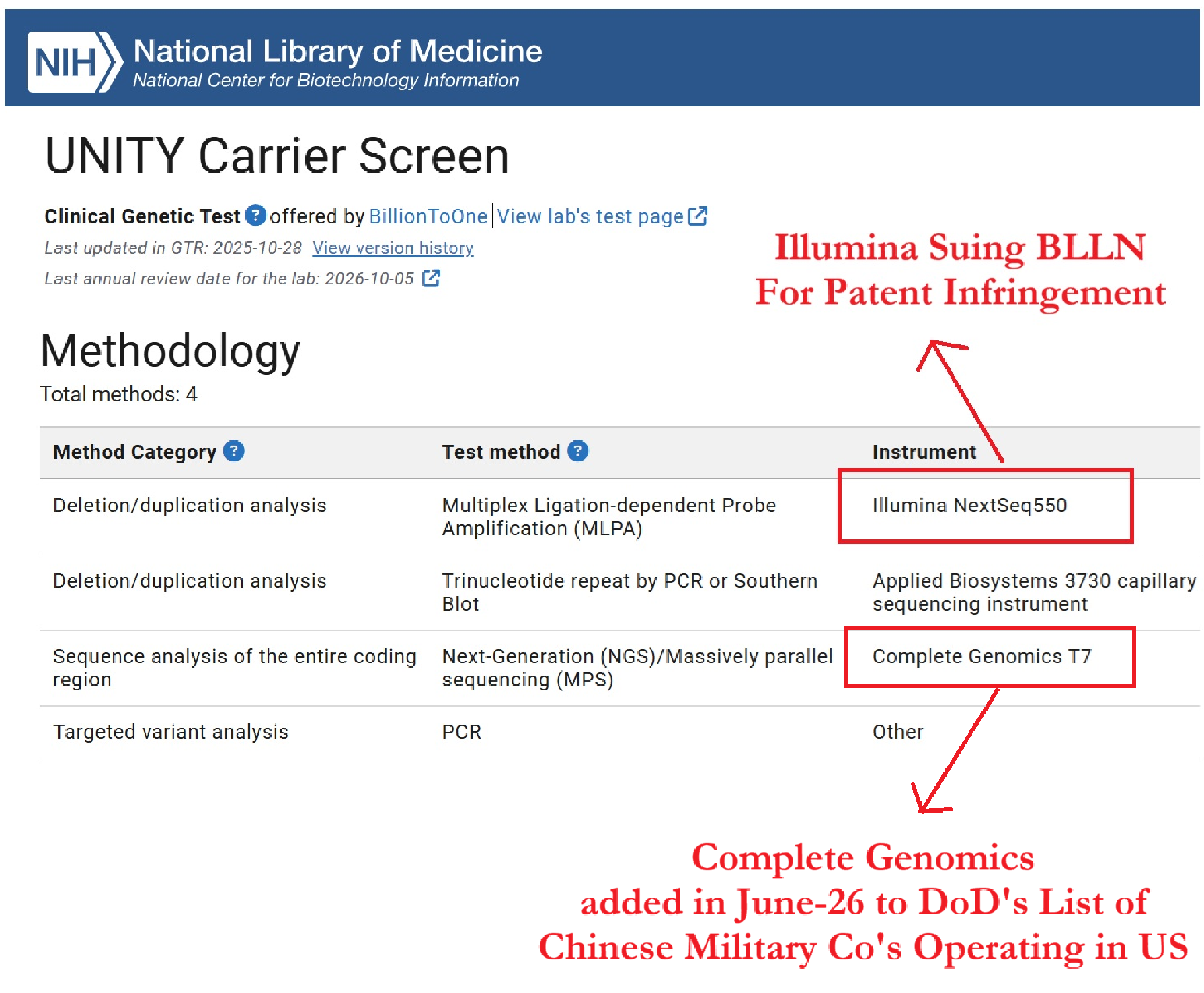
Another BLLN Key Supplier Is on DoD’s June 2026 List of Chinese Military Co’s Operating in the US
Complete Genomics is one of BLLN’s three suppliers from the above NIL list and they are currently listed on the June 2026 updated US DoD’s list of entities operating as a Chinese Military Company in the US.
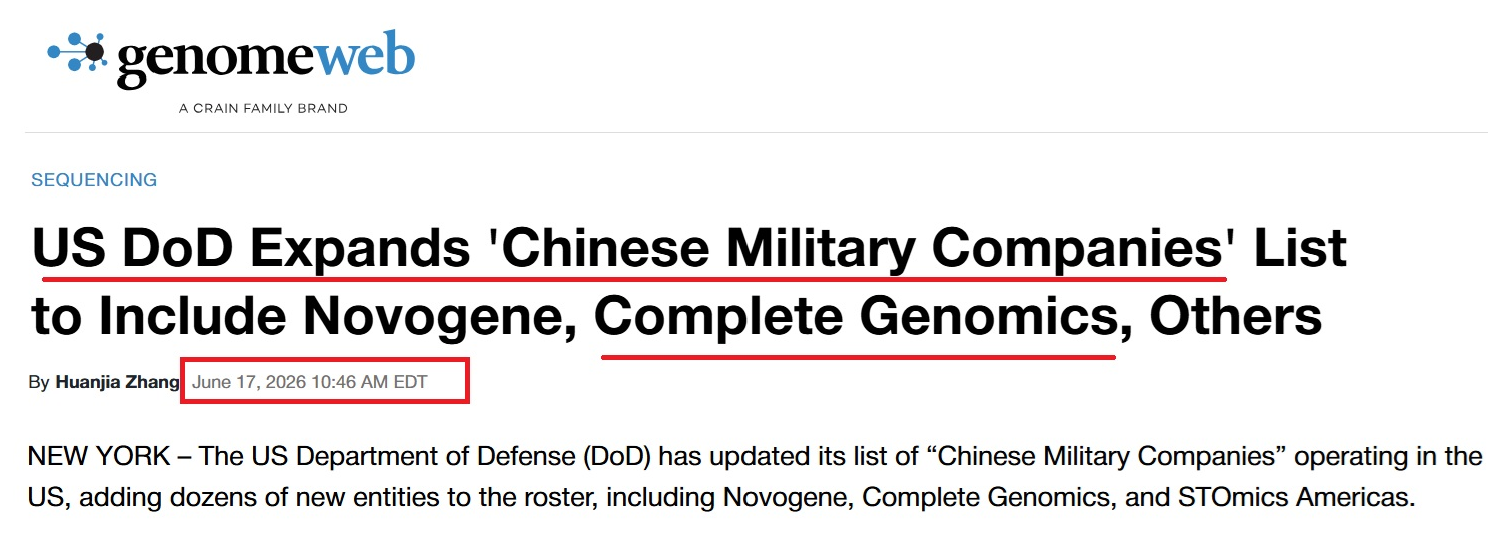
Both Complete Genomics and their previous parent company BGI Group (originally called Beijing Genomics Institute) show up on the list of Chinese Military Co’s Operating in the US.
However, in Feb 2026, before the updated DoD list, BGI announced it would sell Complete Genomics to Swiss Rockets (which appears not to have any Chinese connections). We would not place a Kalshi bet that the deal will not close or that Complete Genomics will not be removed from the Chinese Military Co’s list. But we have uncovered some things that should give us pause.
- Questions on Licensing Agreement – Through our deep research on another Chinese sketchy licensing agreement in the solar space (Trina Solar <-> T1 Energy), we are familiar with sham IP transactions that cause us to be skeptical of any type of Chinese transaction that includes “expanded exclusive license agreement,” which appears to only apply to licensing the tech in the US and Canada.
- CFIUS Review should’ve finished months ago – A CFIUS review should take a max of 120 days – It’s been >260 days since the deal was announced & even has been >160 days since Complete Genomics was added to the Chinese Military company list.
We find it odd that this sale still has not closed ~9 months later, and appears to still be waiting on CFIUS National Security Review.
If the acquisition does not go through, then it would pose a significant risk to BillionToOne because they rely on utilizing Complete Genomics equipment in their labs and more importantly their consumable reagents for assays to run the Unity Tests (86% of revenue). An important ban would disrupt the supply chain for their assays reagents.
Actually, we might place take that Kalshi bet after all if Jump Trading wrote us good enough odds.
Insider Dumping Stock – Sold ~$58 Million Since May 2026 Lock-Up Release
Since BLLN’s lock-up release in May 2026, insiders have been mashing down the sell button. The top 6 insiders have already sold an estimated total of $58.5 million worth of stock.
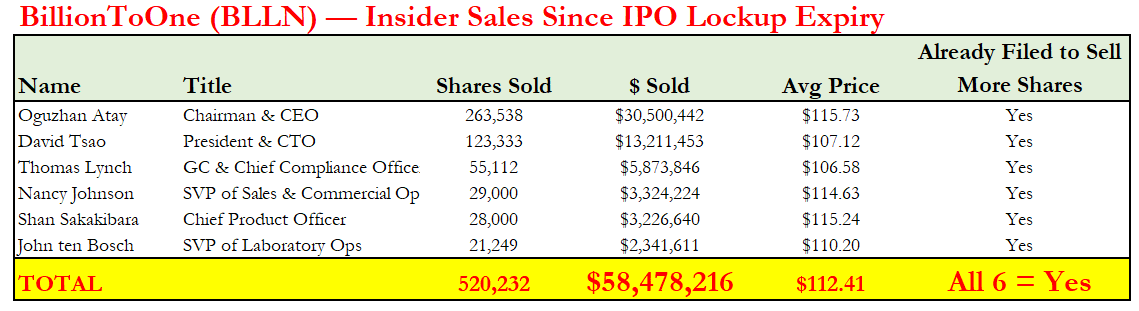
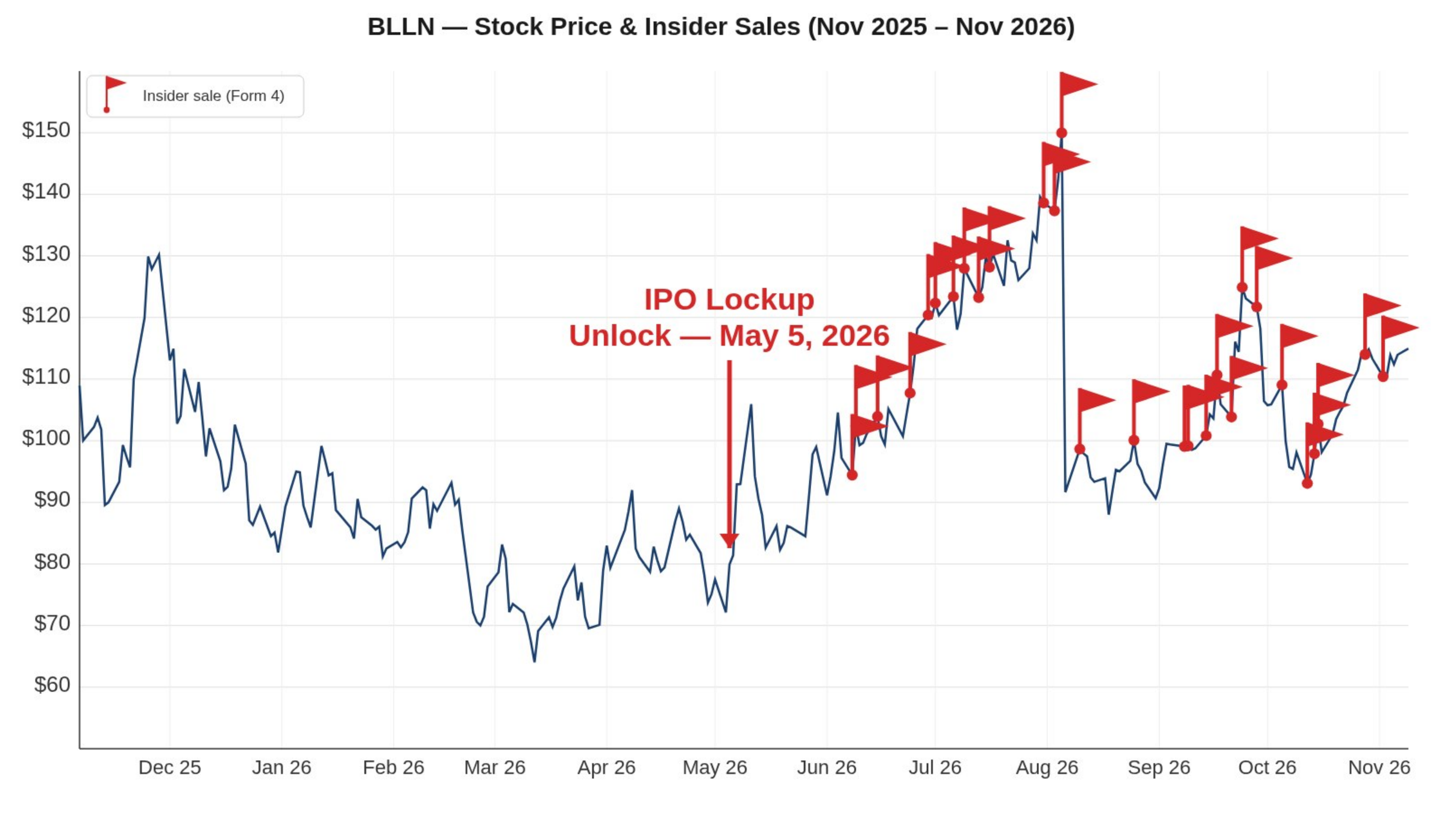
More Insider Sales Coming Soon – All 6 Mgmt Team Members Who Have Sold Just Filed to Sell More Stock
Don’t expect the selling to stop anytime soon.
All top 6 insiders disclosed in the Q3-10Q that they plan to keep selling, and they registered new 10b5-1 plans to sell a total of ~$24.5 million of stock between them. That sale window opens for them in ~1 month.
Conclusion
It appears there might be an easily explainable reason as to why BillionToOne has higher gross margins than their competitors. If their carrier attachment rate truly is 120% higher than the theoretical max rate, then they are billing way more claims per patient than their competition.
But we think BillionToOne is a house of cards set to come crashing down. The NIPT testing space has been rife with sketchy practices and False Claims Act fines for decades, and it seems that offenders always get caught eventually.
From our FOIAs, interviews with formers, doctors, and genetic counselors, as well as review of documents made by current reps and secret recordings of their sales pitches we have learned that.
- Government regulators already “suspect fraud” and have alleged a “a pattern of inappropriate billing,” and “False Claims Act Violations.”
- BillionToOne is regularly promising to providers that they cap patient insurance deductibles without verifying income (a big no-no!)
- But you don’t even have to believe our interviews, you can read the documents from the reps or even hear a BLLN sales rep pitch for yourself!
- The company has an impossibly high genetic carrier testing attachment rate that is ~170% above the competition.
- That rate is partially driven by a sketchy program, called BabyPeek, which management has never told investors about, and which former employees told us helps boost carrier the test attachment rate even higher.
- Now some insurers are taking drastic actions like refusing to reimburse BLLN’s proprietary CPT Code.
- Wall Street’s hope of an oncology miracle seems completely busted as doctors told us that business is a commodity business and that their product is not differentiated.
- Even worse, doctors that have tried Northstar Response have often received test results that say the opposite of what their patient scans do.
We think BillionToOne is just another healthcare company that is over-earning due to sketchy billing and sales practices, or what the Tennessee OIP would call “Suspect Fraud.” Our estimates show that EBITDA could collapse by >80% as private insurance companies and Medicaid cut reimbursement for genetic carrier tests that should’ve never been run.
Fuzzy Panda is Short BillionToOne (BLLN)
Appendix A – Accounts Receivable Growing 3X Faster Than Revenue
We need to apologize to all our forensic accountants followers and to Ben Axler (aka “the axe” of short-seller forensic accounting) for making you wait until the Appendix to address the fact that Accounts Receivable have grown 3x faster than revenue.
Our short thesis is primarily based on the allegations of Medicaid billing fraud, allegations of insurance fraud, doctors exposing a false negative problem, misleading statements about the product’s efficacy, and of course undisclosed investigations by regulators. Thank you for waiting patiently since you’ve probably spent the last number of pages screaming to yourself “What about the growing accounts receivable? It’s exploding!”
DSO’s (Days Sales Outstanding) have grown from 38 days at IPO to 65 days in Q3.
In simple terms, BLLN is recognizing revenue it hasn’t collected at an accelerating rate. Increasing AR could be especially problematic because Q3’s revenue beat was on the back of ASP increasing from Q2.Rising ASP + rising DSO together historically has been the signature of accruing at reimbursement rates payers haven’t actually paid yet. If cash collections don’t validate the already booked revenue then BLLN will be forced to record a negative revenue true-up later.
We think there might be some obvious reasons why insurance companies have become slow to pay:
- Hint – Allegations of billing fraud
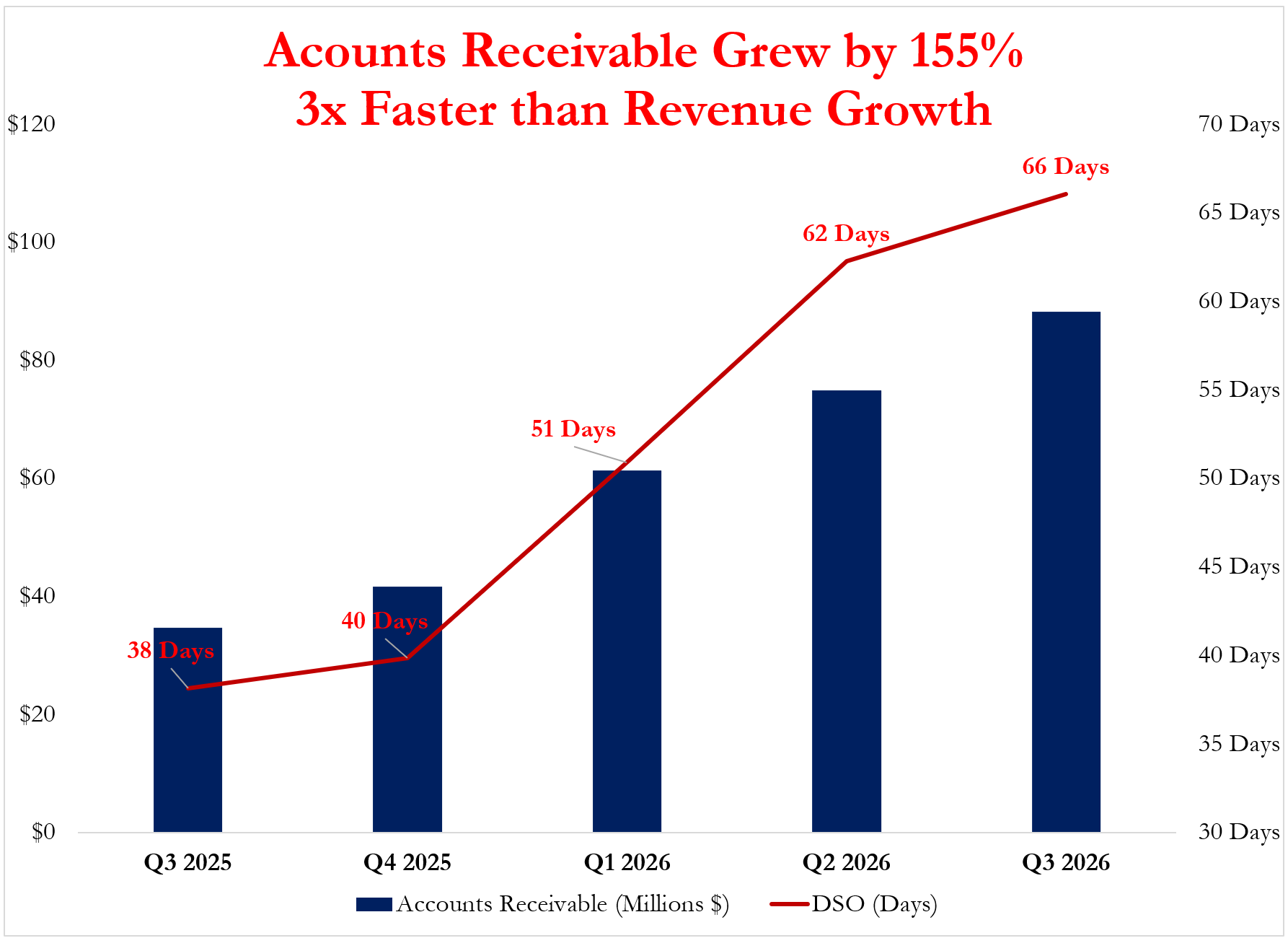
Rising AR could be the canary in the coal mine, which allows forensic financial analysts a window into all the things we uncovered from our own interviews with employees & doctors, and from our FOIA’s. The above chart says it all.
- AR is growing 3x faster than revenue (+155% vs +47% YoY),
- DSO went 38 days (Sept ’25) → 51.5d (Mar ’26)→ 62.3d (Jun ’26)→ 65.3d (Sep ’26).
When AR started to grow in Q1, the CFO gave an explanation that it was only temporary and that it should come down by Q2, and definitely by Q3…yet it hasn’t.
“We are not going to get reimbursement for those until several months from now, and some of that new contracting drove about half of the increase in our AR this quarter… I would expect that will come down, if not by Q2, certainly by Q3.” ~CFO Ross Taylor – Q1’26 CC
Appendix B – The Blood Draws – Allegations of Illegal Overpayments & Kickbacks For Phlebotomy Requires Further Investigation
We were informed of allegations that BillionToOne has been making excess payments for blood draws directly to doctors’ offices. Well actually we are more than just aware, we have source documents which indicate kickbacks for blood draws might have been paid by BillionToOne. Three additional sources indicated suspicious practices by BLLN regarding staffing phlebotomists in Dr’s offices. That becomes an alleged kickback once the company paid phlebotomist does any other work for the Dr office because basically it’s a medical company covering a Doc’s SG&A.
Blood Draw Kickbacks Explanation:
Overpayment for Blood-Draws – Kickbacks to doctor’s offices in the form of overpayment for standard services like blood draws is illegal. Multiple company’s have paid massive DOJ fines for engaging in business practices like this. Our understanding is that for something like blood draws there are essentially two types of payments that BillionToOne can make – if it is a 3rd party like a labcorp or a 3rd party phlebotomists that comes to your house, then BLLN can pay whatever $/blood draw incentivizes the phlebotomist to do the draw; but if it’s an in-house phlebotomist for a doctor office, then any $ reimbursement over the Medicaid rate of ~$9 ($9.34 nationally in 2026) could be considered an illegal kickback. These payments are for small dollar amounts, but on a decent amount of volume they add up. The important difference is whether the higher payment is paid to an independent 3rd party lab or if instead it’s paid to the provider that is ordering the procedure. So, a $30 reimbursement to a doctor’s in-house phlebotomist is effectively viewed as a $9 payment + a $21 illicit kickback.
Past Examples include:
- Health Diagnostic Laboratory (HDL) – which paid a $48.5 million
Covering Drs’ SG&A – Another way to incentivize doctor’s that is deep in the grey area is by offering to provide staff for the doctor’s office. If a company hires a phlebotomist to staff a doctor’s office and they do anything else, then that’s considered the company paying for the doctor’s office’s staff, so that’s a kickback.
We have physical documents that show invoices to BillionToOne from a doctor’s office to get paid higher than Medicaid rates for blood draws.
Doctor’s Office Manager Invoiced BLLN for ~300% More Than Allowable Rate for Phlebotomy
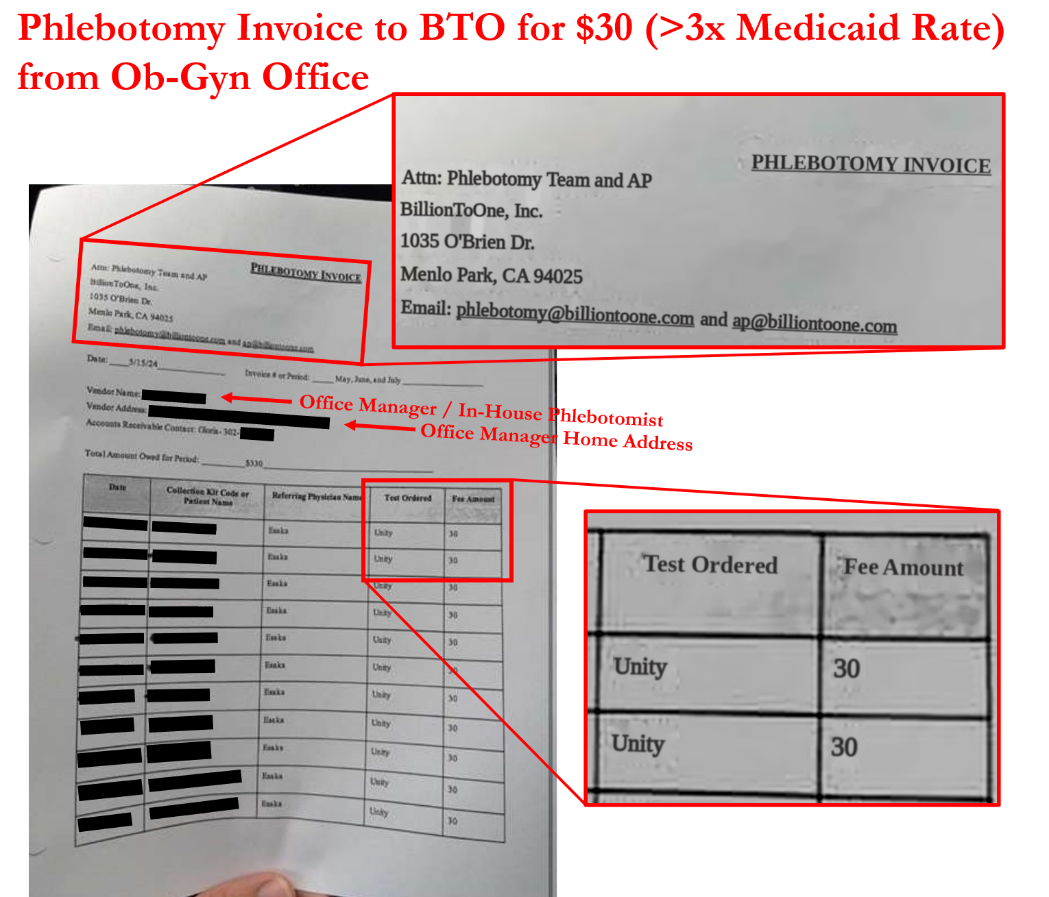
Source – Phlebotomy Invoice Sent by Ob-Gyn’s Office Manager:
- Invoice to BLLN for Phlebotomy
- Vendor = office manager & the in-house phlebotomist at ob-gyn office
- Vendor Address = Office manager’s home address listed
- Fee Amount to BLLN = $30 (3x > Medicaid Rate)
Notes – We called the Ob-Gyn’s office, and they confirmed that the individual (vendor) is actually both the office manager and their in-house phlebotomist, and that the office had no need to work with outside phlebotomy vendors. Additionally, our diligence uncovered no outside businesses registered in that office manager’s name.
We placed multiple phone calls to the office manager to ask if these alleged kickbacks from BillionToOne—were an on-going practice, if this only happened once, if BLLN even paid the invoice, or if there was a better and innocent explanation. They did not return any of our calls.
Excess payments for blood draws have the hallmarks of illegal kickbacks. This invoice gives the appearance that this doctor’s office has been invoicing BillionToOne for a $21 illegal kickback via Phlebotomy payments for each Unity test it ordered.
Staffing Phlebotomists Who Do Additional Work for a Dr Office is Illegal – “We Also Staff, We’ll Send a Phlebotomist to be Employed with you Guys. We’ll Pay, We’ll Pay”
A sales rep’s worst nightmare is when office staff records them in a 1-party consent state because they think they are offering something shady. Unfortunately for BillionToOne, we just so happen to have audio recordings[1] of a BLLN sales rep. In 2026, an obgyn’s staff recorded a sales rep offering to have BillionToOne pay the salary for a phlebotomist for their office and it appears to us that the BLLN rep is suggesting the phlebotomist can do other work for them as well.
“Another thing that we will do, and this just kind of shows you how like this company is going like crazy. So we just went public in November…We also can staff like if you did a certain amount, we also staff, we’ll send a phlebotomist to be employed with you guys. We’ll pay and we’ll pay. The only minimum requirements, they have to take one test to be one of our tests.” ~BillionToOne Sales Rep – Secret Recording
Hear the Clip of the BTO Sales Rep & Judge For Yourself
Some states have a flat ban on lab-placed phlebotomists, so it’s automatically illegal in those states. In other states (like the one for this rep), it is a grey area that becomes illegal once the placed phlebotomist does any other work in the doctor’s office other than drawing blood specifically for the lab paying for their service.
We encourage our readers and regulators to hear the sales pitch from the BLLN rep for yourself and make their own determination if that rep is offering to have BLLN pay for a phlebotomist who would be doing other blood draws and services for the office. We believe that BLLN paying for that would likely be determined by regulators to be an illegal kickback.
A Former Employee & A Nurse Explained that BLLN’s Staffed a Phlebotomist Who Would Draw Blood for Other Labs
Having an embedded phlebotomist draw blood for tests not provided by their employer, take vital signs, or answer phones are viewed as a kickback to the practice in the form of free labor.[2] (see page 65377 under Section F).
That’s why we were surprised to learn that BillionToOne-employed phlebotomists appear to be handling responsibilities beyond blood draws for Unity tests.
A nurse working in an ObGyn practice in Tennessee explained to us how the BillionToOne phlebotomist working out of their practice operated:
“The situation is that the BillionToOne phlebotomist is able to draw … say for example at the new OB (obstetrics) visit, we want (the patient’s) standard labs like their RH (Rhesus) status, the CBC (Complete Blood Count), STI (Sexually Transmissible Infections) testing, all of that completed at the same time that we’re going to do the Unity test.” ~Nurse Practitioner Using Unity – L
She also added:
“They are able to complete LabCorp’s work for them in terms of obtaining that sample.” ~Nurse Practitioner Using Unity – L
In other words, the BillionToOne phlebotomist is acting in the role of a practice-employed phlebotomist in addition to drawing blood for their employer’s screening.
A BillionToOne former employee confirmed for us that company-employed phlebotomists do blood draws for tests beyond Unity, justifying this overreach in responsibilities as creating a more positive experience for the patient.
“Patients aren’t going to want to go and get stuck multiple times So, we often … what we would offer, say they had to have LabCorp request stuff done in addition to ours, but Quest and LabCorp wouldn’t draw everything at once, our phlebotomist would, in some cases, do that. Our phlebotomist would be like, oh, okay, yeah, I’ll draw all your LabCorp stuff as well as this, so that way you don’t have to get stuck again.” ~Former BLLN Operations Employee D
Large False Claims Act Fines For Companies Accused of Engaging in Blood Draw Overpayments
Companies that have been caught engaging in practices like overpayments for blood draws have resulted in large fines.
HDL & Singulex – $48.5 Million Co Settlement + $114 Million Judgement Against Execs – Accused of $10-$17 in Excess Process & Handling Fees on Blood Draws
In 2015, Health Diagnostics Laboratory & Singulex, two cardiovascular labs agreed to a $48.5 million settlement to resolve False Claims Act allegations related to small payments for kickbacks. The government alleged that the labs paid physicians process and handling fees of $10-17 per blood sample and that they regularly waived co-pays and deductibles, which led to physicians ordering medically unnecessary tests that were billed to federal health care programs.
HDL’s former CEO and the two owners of the company’s marketing were also found guilty by a jury for violations of the Anti-Kickback Statute and they were hit with an additional judgment of $114 million.
Boston Heart Diagnostics – $26.7 Million False Claims Act Settlement – Accused of Paying $15-$25 per Blood Draw
Boston Heart was accused of indirectly paying processing and handling fees and waiving patient copays and deductibles. They were paying above the standard Medicaid blood draw fee, and the complaint states they were paying $15-$25 per blood draw. In November 2019, Boston Heart agreed to a $26.67 million settlement to resolve the False Claims Act allegations.
We are not certain if these alleged illicit payments and the covering of doctor’s SG&A related to blood draws are part of BillionToOne’s business plans or were just the result of some one-off rogue salesmen. Regardless, the precedent is clearly that if you get caught paying small additional fees for blood draws then the historical consequence is massive False Claims Act Fines.
We are leaving this section as an appendix since we believe it is an area that regulators should investigate further.
Appendix C – Calculating Est Excess Carrier Test Impact on EBITDA
These estimates assume that all of the estimated carrier tests should not have been billed to insurance or Medicaid and that regulators and insurers are able to stop any potential fraudulent charges.
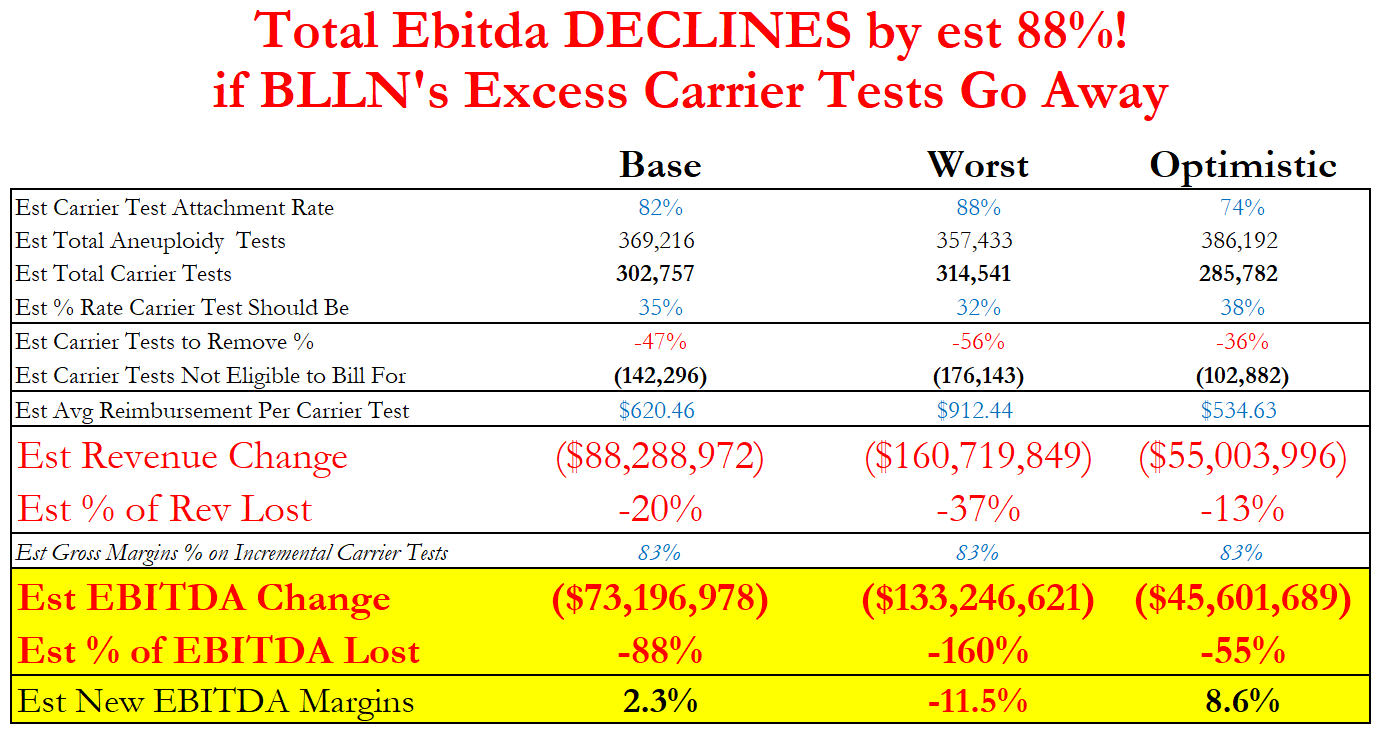
Key Assumptions we used in our estimated calculations:
- Current Carrier Test Attachment Rate:
- Base Case = 82% (Base Case)
- Worst Case = Michigan FOIA showed Est Rate of 88%;
- Optimistic Case = 74% because Interview with Former BLLN employee said 70s-80s% with some regions at 80%+
- Attachment Rate w/out Alleged Excess Carrier Testing: 35%
- Myriad & Natera are profit maximizing company’s so if their attachment rate from MI FOIA data is 31 & 32% so low to mid 30s% is the highest it should be
- Logical maximum if only legal to reimburse once in a lifetime = ~39-40% (the rate of first time pregnancy), so should be <39%
- Est Gross Margin % for Est Excess Carrier Tests Billed – These carrier tests carry a higher incremental GM % since Aneuploidy test is already occurring.
- Est at ~82.5% GM % — Avg 71% GM % rate increases to 82.5% after excluding FedEx shipping + Collection Kit + Blood Draw costs (est at ~11-12% of GMs)
- Reimbursement Rate Per Carrier Test – Est derived from BillionToOne v. Elevance Lawsuit
- Base Case = Elevance began mostly paying $620.46 rate;
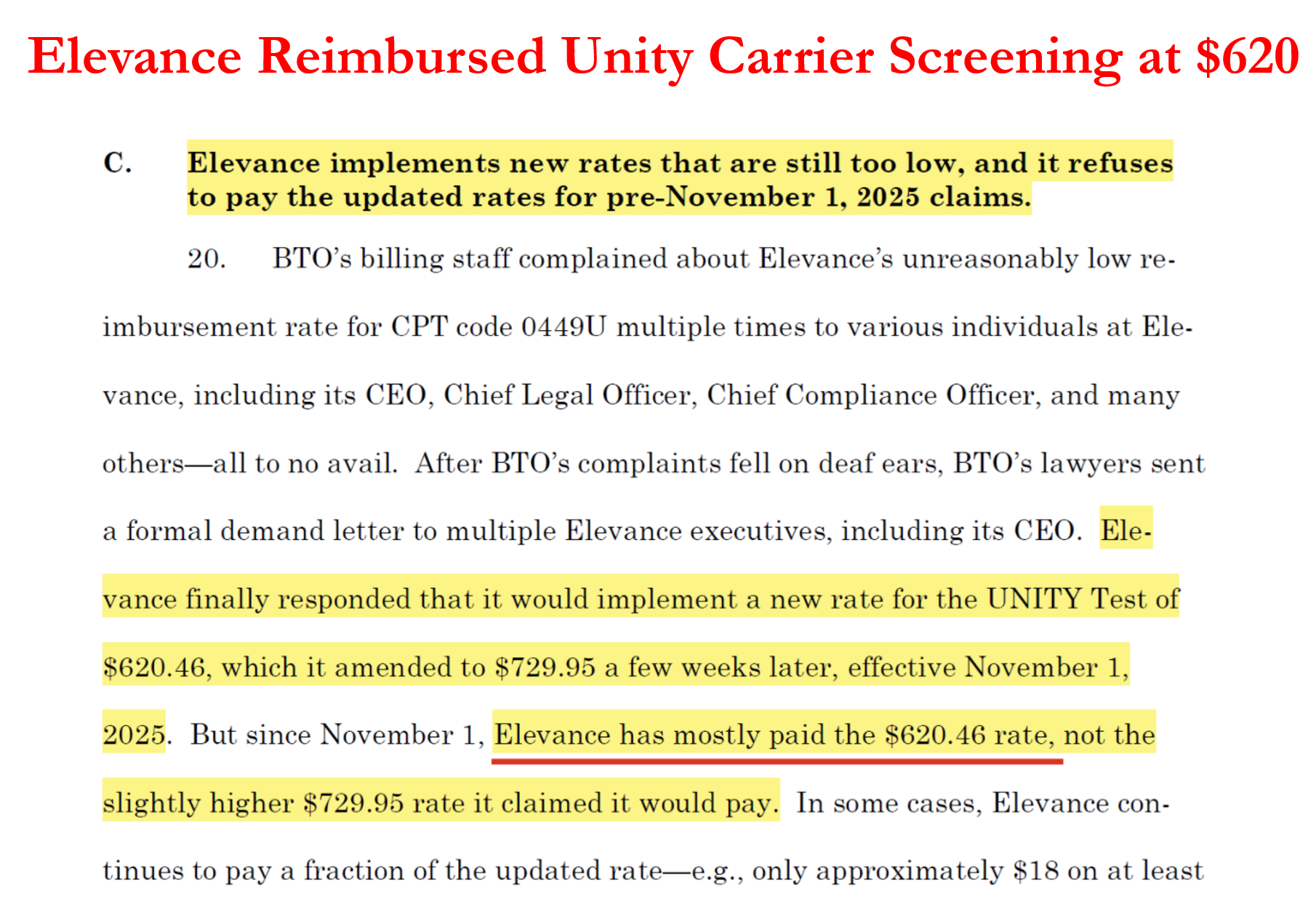
-
- Worst = $912.44 which is 50% of the disclosed Medicare rate for Unity Carrier is $1824.88; Optimistic = BLLN’s Avg Price/Test LTM = $534
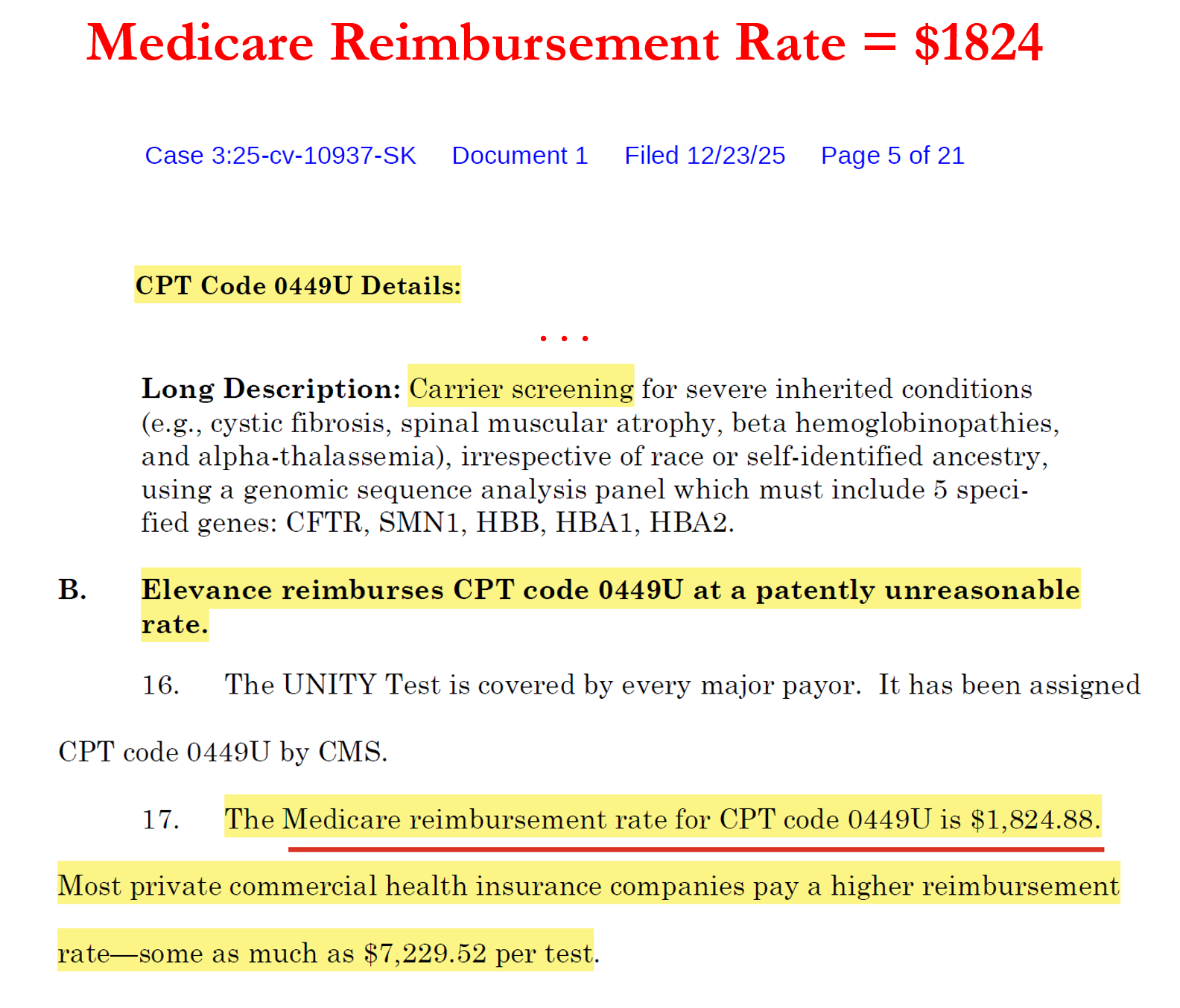
Other Assumptions:
- Oncology rev/Prenatal revenue = est % of tests are Prenatal tests = 88.4%
- Reported Total Tests – If 1 patient gets Unity Carrier & Unity Aneuploidy it counts as 2 tests. This matches up with BLLN’s claims of testing 1/10 of babies in the US 3.5m vs LTM total of 760k tests delivered.
Appendix D – Texas Medicaid Data – BLLN Appears to be Bundling Microdeletion Screening At ~2X the Competition
It’s not just carrier screening that appears to be over-prescribed by doctors working with BillionToOne. We obtained data from Texas Medicaid via a public records request that compared the amount of so-called microdeletions screening being done by BillionToOne and competitors Natera and Myriad. Microdeletions are tiny missing fragments of DNA within a chromosome that can result in conditions including DiGeorge Syndrome, which can result in heart defects and cleft palates. BillionToOne submitted claims for microdeletion screening at a rate of 51% of its rate of aneuploidies testing, indicating those 2 tests were bundled in more than half of all prenatal screenings which was almost double the rate of Natera’s bundling.
Natera had a bundling rate for microdeletions of 26% while Myriad appeared to be bundling only 14% of the time.
Texas Medicaid Data (2024 – 2025)

Source: Texas Medicaid data
(Note – Unfortunately, the initial response from Texas’s Medicaid Office did not include data on carrier testing, so we can’t compare Texas to Michigan but we have sent follow-up requests to try to get that additional data as well.)
Fuzzy Panda Research Disclosures, Disclaimer and Terms of Service:
By downloading from or viewing material on this website and/or by reading this report, you agree to the following Terms of Service. You agree that any use of the research in this report or on this website is at your own risk. In no event will you hold Fuzzy Panda or any affiliated party, including officers, directors, employees, consultants, and agents of Fuzzy Panda or any companies affiliated with any of them, liable for any direct or indirect losses caused by your use of or reliance on information on this site or in this report. You further agree that you will not rely on any information in this report or on this website, to do your own research and due diligence before making any investment decision with respect to companies or securities mentioned herein, and that you will consult with your own investment professionals prior to any investment decisions. You represent that you have sufficient investment sophistication to critically assess the information, analysis and opinions in this report or on this site. You further agree that you will not communicate the contents this report or other materials on this site to any other person unless that person has agreed to be bound by these same Terms of Service. If you accessed, download, or receive this report or the contents of other materials on this site as an agent for any other person, you are binding your principal to these same Terms of Service.
As of the publication date of this report, Fuzzy Panda, and possibly any companies affiliated with it or its members, partners, employees, consultants, clients and/or investors (the “Fuzzy Panda Affiliates”), have a short position in the stock (and/or options, swaps, and other derivatives related to the stock) and bonds of the company covered in this report (the “Covered Company”). Fuzzy Panda and the Fuzzy Panda Affiliates therefore stand to realize significant gains in the event that the prices of either equity or debt securities of the Covered Company declines. There are many factors that can go into a decision to cover the short position(s) in the Covered Company’s securities and it is not possible to predict exactly when or for exactly what reasons Fuzzy Panda and the Fuzzy Panda Affiliates may cover their positions, in whole or part, or otherwise change their investment holdings. As a general matter, Fuzzy Panda and the Fuzzy Panda Affiliates intend to cover some or all of their positions at a time that the price of the Covered Company’s securities are lower than when they were sold short or otherwise invested in. Fuzzy Panda and the Fuzzy Panda Affiliates may cover some or all of their short positions immediately after the publication of this report or an indefinite period after its publication. Similarly, Fuzzy Panda and the Fuzzy Panda Affiliates may cover some or all of their short positions if the price of the Covered Company’s securities move a small amount or after moving a larger amount. Fuzzy Panda and the Fuzzy Panda Affiliates intend to continue transactions in the Covered Company’s securities for an indefinite period after the publication of this report, and they may be short, neutral, or long at any time after the publication of this report regardless of any opinions, possible stock prices or valuations, or other views stated in the report. Fuzzy Panda will not update any report or information on this website to reflect any changes in the investments of Fuzzy Panda or the Fuzzy Panda Affiliates that existed at the time of the publication of this report, or any new positions in any securities of the Covered Company.
This report and the Fuzzy Panda website is informational and describes the opinions of Fuzzy Panda. This report is not an offer to sell or a solicitation of an offer to buy any security, and Fuzzy Panda does not offer, sell or buy any security to or from any person through this report or the Fuzzy Panda website. This report is not a recommendation or advice to short or otherwise invest in or trade any security. Fuzzy Panda does not render investment advice to anyone unless it has an investment adviser-client relationship with that person evidenced by a formal written agreement. You understand and agree that Fuzzy Panda does not have any investment advisory relationship with you, or owe any fiduciary or other duties to you. Giving investment advice requires knowledge of your financial situation, investment objectives, and risk tolerance, and Fuzzy Panda has no such knowledge or information about you.
If you are in the United Kingdom, you confirm that you are accessing research and materials as or on behalf of: (a) an investment professional falling within Article 19 of the Financial Services and Markets Act 2000 (Financial Promotion) Order 2005 (the “FPO”); or (b) high net worth entity falling within Article 49 of the FPO.
Fuzzy Panda’s research and reports express the opinions of Fuzzy Panda, which are based upon generally available information, field and online research, and inferences and deductions through due diligence and the analytical process. Fuzzy Panda believes that all information contained in this report has been obtained from accurate and reliable public sources, and no material nonpublic information was obtained from any person who had a duty to keep information confidential. However, Fuzzy Panda cannot be certain that the information it has relied upon in this report is accurate. The information and opinions in this report are therefore presented “as is,” without warranty of any kind, whether express or implied. Fuzzy Panda makes no representation, express or implied, as to the accuracy, timeliness, or completeness of any such information or with regard to the results to be obtained from its use. This report also contains forward looking statements about what may occur in the future. The future cannot be predicted with certainty and any of the forward-looking statements about projections, beliefs, estimates, assumptions, outcomes, or any other future event may be incorrect. Among other things, any forward-looking statements may be rendered inaccurate by incorrect assumptions, incorrect methodologies, unforeseen risks and events, or other variables. Any opinions about the possible future stock price of the Covered Company or fair value of its securities is not a price target and does not mean or imply that Fuzzy Panda or the Fuzzy Panda Associates will hold any investment until such price or valuation is met. Further, all expressions of opinion, including any conclusions drawn from Fuzzy Panda’s analysis, are subject to change without notice, and Fuzzy Panda does not undertake to, and will not, update or supplement any reports or any of the information, analysis and opinion contained in them.
You agree that the expressions of information in this report are copyrighted and owned by Fuzzy Panda Research, and you therefore agree not to distribute this report, any excerpts from it, or information from the Fuzzy Panda website (whether the downloaded file, copies / images / reproductions, or the link to these files) in any manner other than by providing the following link: www.fuzzypandaresearch.com. If you have obtained Fuzzy Panda’s research in any manner other than by accessing or downloading from that link, you may not read such research without going to that link and agreeing to the Terms of Service. You further agree that any dispute between you and Fuzzy Panda and/or any of the Fuzzy Panda Affiliates arising from or related to the material on their website shall be governed by the laws of the State of California, without regard to any conflict of law provisions. You knowingly and independently agree to submit to the personal and exclusive jurisdiction of the state and federal courts located in California and waive your right to any other jurisdiction or applicable law. The failure of Fuzzy Panda to exercise or enforce any right or provision of these Terms of Service shall not constitute a waiver of such right or provision. If any provision of these Terms of Service is found by a court of competent jurisdiction to be invalid, the parties nevertheless agree that the court should endeavor to give effect to the parties’ intentions as reflected in the provision and rule that the other provisions of these Terms of Service remain in full force and effect, in particular as to this governing law and jurisdiction provision. You agree that regardless of any statute or law to the contrary, any claim or cause of action arising out of or related to this report or the material on this website must be filed within one (1) year after such claim or cause of action arose or be forever barred.
This BillionToOne Rep’s sales pitch was recorded in a 1-party consent state by the office staff from an ObGyn practice. We learned they recorded this pitch because they felt he was shady and making false promises. We are happy to share the full recording with regulators but since the sales rep hasn’t consented to us publishing his shady pitch, we aren’t publishing the full transcript which would reveal his name & territory. ↑
https://www.hchlawyers.com/blog/2021/june/free-phlebotomist-in-your-medical-office-be-awar/#:~:text=*%20Specify%20the%20tasks%20the%20phlebotomist%20is,from%20AKS%20violations%2C%20you%20must%20remain%20vigilant. (“The scope of the lab employee’s duties should be limited solely to those necessary for specimen collection and testing specifically for the outside lab and nothing else.” ↑